
SITA Export Guide
Who Should Use this Guide?
Companies or entrepreneurs from Suriname who are interested in exporting and seeking guidance throughout the export process: including procedures, steps to follow, requirements, and more.
- Exporting goods involves placing physical products in another country or free trade zone.
- Exporting services involves delivering intangible value such as expertise, technical assistance, or digital solutions to clients in another country, without the need to move physical products.
Since the export process is often perceived as complex, SITA aims to assist you with this simple guide, designed to provide clarity and support throughout your export journey.
Whether you are a new to exporting or have some experience, find out more about how to start or expand your exports, you can learn about the Key aspects for exporting, including process stages, export requirements, strategic planning, export barriers, sources of financing, and decisions for adapting offerings to international markets:

Have you thoroughly assessed your business's readiness for export and the underlying motivation for internationalisation?
Are you aware of Suriname's current trade integration agreements with the rest of the world and the benefits they offer for exporting Surinamese products or services?
Does your company have a Strategic Planning for Export?
Are you familiar with the different market entry strategies for international markets?
Have you defined your exportable offer (product or service) but are still unsure which markets have the highest export potential?
Do you have a defined Marketing Mix strategy for Product, Price, Place, and Promotion?
Are you familiar with the sources of financing for internationalisation available to Surinamese businesses?
Are you aware of the first steps to export from Suriname?
Do you know the tariff code that applies to your product for export and are you aware of the tools available to identify it?
Do you have knowledge of the mandatory requirements and the procedure to comply with export regulations from Suriname at a general level?
Do you have knowledge of the origin requirements and steps to follow for exporting from Suriname at a sector-specific level?
Are you aware of the key aspects of the supply chain and logistics in international trade?
Do you know the different types of international transport and the contractual arrangements that apply to transportation?
Are you familiar with the various types of protection of goods for international trading?
Do you understand the different INCOTERMS and the implications each one has on the cost and responsibilities of the exporter and importer?
Are you aware of the standard documentation required for export?
Are you interested in learning about the requirements and key aspects for exporting to these regions?
2. Environment and Motivation for Exporting
This section describes the key elements that influence a company's decision to export and the strategic considerations that follow.
It begins by exploring both internal and external factors that shape export strategies, including motivations and obstacles that companies may encounter. The section also outlines the main reasons businesses pursue internationalization, distinguishing between proactive initiatives and reactive responses.
Additionally, it highlights common export barriers—whether internal challenges or external, exogenous constraints.
Finally, it presents an overview of Suriname’s involvement in international trade agreements, emphasizing how these multilateral and bilateral arrangements can support and facilitate the export process.
What you will find in this section:
| Subsection | Description | Further Information |
|---|---|---|
| 2.1 Why Export? | Discusses both proactive motivations and reactive motivations for internationalization. | Click to learn more about Reasons for Internationalisation |
| 2.2 Need for a clear Export Strategy | Describes both external and internal factors that can influence export strategies. | Click to learn more about Issues Affecting Export Strategy |
| 2.3 Barriers to Exporting | Describes common barriers to export, and exogenous barriers, that companies may face in the export process. | Click to learn more about Barriers to Exporting |
| 2.4 Suriname's Trade Integration Agreements | Explains Suriname's participation in various international multilteral and bilateral agreements as well as the benefits these agreements provide. | Click to learn more about Suriname's Agreements |
2.1 Why Export?
Motivations can be proactive or reactive:
- Proactive motivations: Benefits and growth, technological competition, opportunities in foreign markets. For example, for Surinamese companies, the ease and opportunities to do international business thanks to integration and international cooperation agreements such as CARICOM are a reason to internationalise.
- Reactive motivations: Competitive pressures, saturated national market, excess production. For example, in Suriname the size of the market is limited, so the growth of the business sector depends on its internationalization to expand the market.
Tip:
Check if your company is ready to export using the "Export Readiness Checklist" tool provided by SITA.
2.2 Need for a clear Export Strategy
Before exporting, it is important for companies to consider some external and internal issues that can help plan their export strategy:
External issues that may affect the export strategy:
- Be informed of trends, know what customers want. Is your product or service fully market fit?
- Identify market dynamics. Who is currently supplying the demand? What is the distribution of the current market?
- How is the participation of the main actors?
- Know the target segment. What are the characteristics of the target market or potential buyers?
- What is the size of the market?
Internal issues that may affect the export strategy:
- Review the status of your company in administrative, financial, legal aspects and market experience.
- Validate the potential of your product or service.
- Identify the differentiating factor. Determine what your company's strengths and weaknesses are.
- Analyse the behaviour of your product or service in the markets.
- Identify your direct competitors (in the national and international market).
2.3 Barriers to Exporting
An export barrier is any element or factor, internal or external, that hinders or dissuades the company from starting, maintaining or increasing export activity.
After reviewing most of the existing studies, it is proposed to group export barriers or obstacles into four generic categories:
- Knowledge barriers: Lack of knowledge of markets, lack of information about opportunities.
- Resource barriers: Lack of production capacity, financial difficulties.
- Procedural barriers: Bureaucracy, cultural and linguistic barriers.
- Exogenous barriers: Exchange rate risk, political instability.
2.4 Suriname's current trade integration agreements with the rest of the world
Suriname belongs to several integration processes such as:
- CARICOM: Member State of the Caribbean Community and the Common Market
- CARIFORUM: Member State of the Caribbean Forum Group of African, Caribbean and Pacific States
In addition, Suriname has a number of multilateral and bilateral agreements that make it a country with good access to other markets. These agreements represent a competitive advantage for exporters, since they apply reduced or zero tariffs. To take advantage of these opportunities, it is important to understand the key concepts and agreements that shape Suriname’s international trade environment.
Contents of this subsection:
2.4.1 Most-Favoured-Nation (MFN) Provisions
The Most-Favoured-Nation (MFN) principle is a fundamental rule in international trade, ensuring that any advantage, favour, privilege, or immunity granted by one country to the products, services, or nationals of another country must be extended to all other WTO members.
Key Aspects of MFN:
- Non-Discrimination: If a country lowers tariffs or removes trade barriers for one trading partner, it must do so for all WTO members.
- Application in Goods and Services: MFN is a cornerstone of both the General Agreement on Tariffs and Trade (GATT) (for goods) and the General Agreement on Trade in Services (GATS) (for services).
- Exceptions: Certain exceptions to MFN exist, such as regional trade agreements (e.g., EU, NAFTA) and special treatment for developing countries under the Generalized System of Preferences (GSP).
2.4.2 General Agreement on Trade in Services (GATS)
The General Agreement on Trade in Services (GATS), established under the WTO framework in 1995, sets rules for international trade in services. It aims to ensure transparency, predictability, and non-discrimination in the services sector.
Key Features of GATS:
- MFN Treatment: Countries cannot favour one WTO member’s services over another unless an exception applies (such as regional agreements).
- Market Access Commitments: Countries commit to allowing foreign service providers access to their markets under specific conditions.
- National Treatment: Once a foreign service provider enters the market, it must be treated no less favourably than domestic competitors.
- Four Modes of Supply: GATS covers services supplied through:
- Cross-border supply (e.g., online services).
- Consumption abroad (e.g., tourism, education abroad).
- Commercial presence (e.g., foreign banks setting up branches).
- Presence of natural persons (e.g., professionals working temporarily in another country).
Both MFN provisions and GATS are crucial for maintaining fair, open, and non-discriminatory trade policies across international markets.
2.4.3 Trade integration agreements that benefit Suriname:
Multilateral agreements
- WTO Treaty
- CARICOM-Costa Rica Free Trade Agreement
- Free Trade Agreement between CARICOM and the Dominican Republic
- Second Protocol to the Trade and Economic Agreement between CARICOM and the Government of the Republic of Cuba
- CARIFORUM-EU Economic Partnership Agreement
- Economic Partnership Agreement between CARIFORUM and the United Kingdom
Bilateral agreements
- Agreement with Brazil on Tariff Concessions for Trade in Rice
- Trade Agreement between the Republic of Suriname and the Republic of Indonesia
- Memorandum of Understanding Suriname-Antigua and India
- Memorandum of Understanding Suriname-Antigua and Barbuda
- Memorandum of Understanding Suriname – Barbados
- Memorandum of Understanding between Suriname and Dominica
- Memorandum of Understanding between Suriname and Ghana (Tourism and Mining)
In addition, Suriname has a number of multilateral and bilateral agreements that facilitate trade with other markets. However, not all of these agreements grant reduced or zero tariffs. Exporters should verify the specific benefits and conditions of each agreement before engaging in trade activities.
2.4.4 CARICOM and the EU Preferential Trade Agreement
Suriname benefits from the CARICOM-EU preferential trade agreement, which enhances Suriname's access to the European market. This agreement allows Suriname and other CARICOM member states to export goods to the EU with reduced or zero tariffs, under preferential terms.
One of the key advantages of the CARICOM-EU agreement is the accumulation of origin principle. This allows products originating from CARICOM states (such as Suriname) to benefit from EU preferences even if they undergo processing or transformation in another CARICOM country, as long as the final product meets the EU’s origin requirements.
Under this accumulation principle, goods processed in other CARICOM countries can still count as originating from Suriname (or any other CARICOM member state), making it easier for Surinamese businesses to access EU markets without facing significant barriers or high tariffs.
Example: Exporting wood from Suriname
Let’s consider an example involving wood to illustrate how this mechanism works in practice:
Step 1: Export from Suriname: A Surinamese company exports raw timber to a CARICOM member state, such as Dominican Republic. While the timber is sourced from Suriname, it may not meet the EU’s specific rules of origin if it is shipped directly to the EU, as the raw timber has not undergone sufficient transformation.
Step 2: Processing in Dominican Republic: In Jamaica, the timber is processed, for example, by sawing the logs into planks or manufacturing furniture components. Under the accumulation of origin principle, this processing is considered as part of the transformation that qualifies the product for EU preferential treatment.
Step 3: Export to the EU: The processed wood (planks or furniture parts) can then be exported to the EU at reduced or zero tariffs. Even though the raw timber originated in Suriname, the final product, as processed in Dominican Republic, can still be considered as originating from Dominican Republic, thanks to the accumulation principle in the CARICOM-EU agreement.
This mechanism helps Surinamese companies by allowing them to collaborate with other CARICOM countries for processing and transformation, while still benefiting from preferential access to the EU market.
2.4.5 Practical Aspects of Trade Integration Agreements
To gain a deeper understanding of the applicable tariffs for each product in the various target markets, please refer to the section "Market Research", subsection "Tariff Barriers", which highlights the importance of this analytical variable in defining the target market. It also provides various sources of information to check the applicable tariffs for our product in the destination market.
It is important to note that, in order to benefit from preferential trade agreements, companies must prove the origin of their products to the customs authorities of the destination country. There are specific procedures and documents for this purpose, such as the Certificate of Origin, which is the official document issued by the competent authority of the exporting country. This document verifies the country where the product has been produced, manufactured, or processed and must be presented as part of the customs clearance process when importing goods.
TIPS:
- Visit the CARICOM website for detailed information as one of the main integration processes from which Surinamese companies can benefit.
- For more insights into the applicable tariffs in different target markets, consult the section Market Research, subsection "Tariff Barriers".
- Find further information and details regarding the Certificate of Origin and other commercial documents required for export in the following section: Standard Documentation and Procedures in International Trade.
- Access our FAQ section, where we answer common queries from exporters, address key concerns, and provide practical tips for overcoming challenges in the export process.
3. Strategic Planning for Export
This section of the guide addresses the key strategic decisions for a company to internationalise. Exporting initially requires a market selection to determine the specific characteristics of the country or region to which you want to export, identifying export prices, taxes, legal requirements, identification of trade and double taxation agreements, supply and demand behaviour and other relevant aspects by analysing potential markets and identifying opportunities and threats.
The roadmap should contain at least:
- Exportable supply: the company's products with the greatest opportunities to be in demand and successful in international markets
- Market analysis: Countries of interest, resulting from the completion of a structured exercise of selection of priority markets.
- Objectives of internationalization
- Action Plan
- Resources required - budget
- Deadlines (Schedule)
- Mechanisms for monitoring and controlling the execution of the plan.
Visit the SITA website for comprehensive information on training, promotion, and support services for Surinamese companies seeking internationalization.
What you will find in this section:
| Subsection | Description | Further Information |
|---|---|---|
| 3.1 Modes of Entry into International Markets | Discusses the various forms of entry into international markets. The choice of entry method has direct implications on resource allocation, risks, marketing channels, and operational control. | Click to learn more about Modes of Entry into International Markets |
| 3.2 Market Research | Market research is vital to assess potential target markets using various variables. The focus should be on both market potential and the accessibility and risks related to entering the market. | Click to learn more about Market Research |
| 3.3 Marketing Mix | Covers the four Ps of marketing (Product, Price, Place, Promotion) and how to adapt them for international markets. | Click to learn more about Marketing Mix |
| 3.4 International Risk Management | Explores the main risks associated with internationalisation and strategies to manage these risks effectively. | Click to learn more about International Risk Management |
| 3.5 Sources of Finance for Internationalization | Exporters and businesses looking to expand internationally from Suriname can access various resources and financial support programs. Key institutions and initiatives that provide funding, trade finance, and business development support are detailed in this section. | Click to learn more about Sources of Finance for Internationalization |
3.1 Modes of Entry into International Markets
The choice of the way to enter new markets is one of the most important decisions in the international expansion strategy. The form of entry has direct effects on the results that will be obtained in the different countries, since the resources used, the risks assumed, the marketing channel and the control of operations will be different for each type of option.
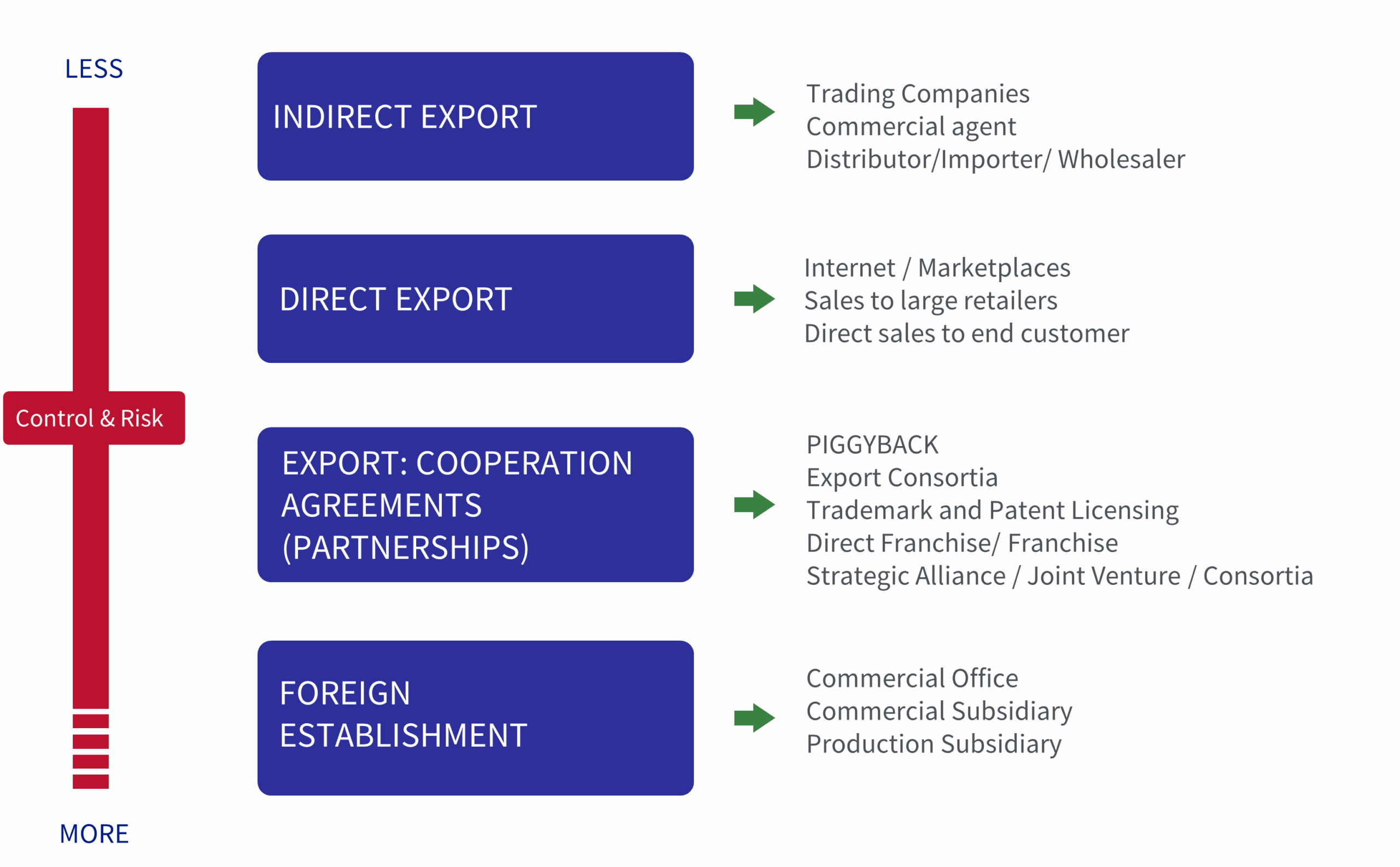
There are four main methods of entry into international markets:
- Indirect Export: An intermediary, such as an importer or distributor, is used to resell the products to the end customer.
- Direct Export: The company sells directly to customers abroad, either through its own sales team or through e-commerce.
- Partnership agreements: The company forms alliances to share risks and benefits, including agreements such as licenses, franchises, consortiums or Joint Ventures.
- Local Presence: The company establishes a physical presence in the target market, such as a branch, branches, or commercial subsidiary.
Below is a diagram with the forms of entry into international markets from the lowest to the highest degree of control and risk assumed by the exporting company. It is important to note that companies
Illustration 1 Outline of Entry Forms in International Markets
Source: Own elaboration
3.2 Market Research
Before going international, companies must carry out general research based on different variables (also referred to as ‘indicators’) to carry out the selection of target markets. Below is a table with the variables that are usually analysed:
| Variable | Description |
|---|---|
| Economic growth of the country | A growing economy offers more opportunities for business expansion and long-term sustainability. |
| Purchasing power per capita | Understanding income levels helps determine if consumers can afford your product or service. |
| Volume and evolution of imports | High import volumes indicate strong demand and lower entry barriers for foreign products. |
| Exports from the country of the company | Identifying competing suppliers helps assess market saturation and potential gaps. |
| Tariff barriers | Import taxes can significantly affect pricing and competitiveness in a foreign market. |
| Sanitary and phytosanitary measures and technical regulations | Compliance with health and safety standards is essential for market entry. |
| Political and commercial risk | Stability and predictability in a country reduce uncertainties in business operations. |
| Ease of doing business | Business-friendly environments facilitate company setup and operational efficiency. |
| Transparency and corruption | Low corruption levels improve legal security and reduce risks in business dealings. |
Below is a table outlining the key indicators essential for conducting a market research study:
| INTERNATIONALIZATION INDICATORS | ||
|---|---|---|
| MARKET POTENTIAL BARRIERS | ||
| Indicator name | Why it matters | Source |
| Economic growth | A growing economy provides more business opportunities and long-term sustainability. | IMF - World Economic Outlook, World Bank Data |
| Purchasing power per capita | Indicates whether consumers can afford your product or service. | CIA World Factbook, WorldBank Data |
| Import volume and trends | High import levels signal strong demand and easier market entry. | Trademap, UN Comtrade, Eurostat |
| Exports from domestic market | Understanding competitors and identifying gaps in the market. | Trademap, UN Comtrade, Eurostat |
| ACCESSIBILITY AND RISK VARIABLES | ||
| Indicator name | Why it matters | Source |
| Tariff barriers | Import taxes impact pricing and competitiveness in foreign markets. | Market Access Map - ITC |
| Sanitary and phytosanitary measures & technical regulations. | Compliance with health and safety regulations is necessary for market entry. | Global Trade Alert |
| Political and Commercial Risk | Political instability and business risk can affect investment decisions. | COFACE Global Country Risk Map |
| Ease of doing business | Business-friendly environments facilitate market entry and operations. | World Bank - Doing Business Report |
| Transparency and Corruption | Higher transparency reduces risks and enhances legal security. | Transparency International - Corruption Perceptions Index |
Research both Market potential and Accessibility and risk variables if you are in the early stages of internationalization or still defining your target market.
Contents of this subsection:
| Market Potential variables |
| Accessibility and risk variables |
3.2.1 Market Potential variables
Understanding the potential of a target market requires the analysis of key economic indicators that directly influence the success of internationalization efforts. Economic growth projections, purchasing power per capita, the volume and evolution of imports, and the origin of current suppliers provide a solid foundation for evaluating market attractiveness.
A country with sustained GDP growth and high purchasing power is more likely to offer greater opportunities for entry and expansion. Similarly, high import volumes of a specific product signal existing demand, while knowing which countries already export to that market—especially if they have a similar profile to Suriname—can highlight real opportunities for competitive positioning.
Contents of this subsection:
3.2.1.1 Economic growth of the country
The first data to analyse is the growth of the Gross Domestic Product (GDP) as well as the forecast for the coming years in each of the countries studied. A growing and sustained demand (GDP growth above 5%) will facilitate market access. On the other hand, in a situation of stagnant GDP (around 1%) or in recession, it will be exceedingly difficult to enter the country.
There are various sources that offer forecasts of economic growth by country. Among the most widely used is the International Monetary Fund, which publishes the World Economic Outlook on a quarterly basis, which revises and updates GDP growth forecasts by country.
3.2.1.2 Purchasing power per capita
A fact that also conditions demand is the income level of each country, which is measured by Purchasing Power Parity per capita (PPP), which is the best exponent of the purchasing power of the inhabitants of a country. The CIA’s online publication The World Factbook provides this information.
3.2.1.3 Volume and evolution of imports
An essential criterion is the volume of imports that the company sells into the country. It is the figure that best reflects the potential of the market and, in turn, one that is easiest to obtain.
To find out what a country imports and exports of each product, you must first identify the 4-digit tariff code (heading) or, preferably, the 6-digit tariff code (subheading). This identification can be made through several official sources:
- World Customs Organization Harmonized System Tool
- Harmonized Tariff Schedule Search of the US Government
- TARIC Consultation of the European Commission.
Once the tariff code is known, import statistics by country and product can be obtained from different databases such as:
3.2.1.4 Exports from the country of the company
This variable will indicate which countries supply imports to our target market, providing a global perspective and helping to identify opportunities for Suriname to export to this country.
A potential business opportunity could be if other CARICOM countries are already exporting a significant volume of our product to this market. If countries with a similar profile to Suriname are engaging in exports, there may be real business opportunities.
As in the previous variable, export statistics by country and product can be obtained from sources such as Trademap, United Nations, UN Comtrade, or the European Union, Eurostat, among other sources.
3.2.2 Accessibility and risk variables
It is essential to understand the key barriers and factors that affect market accessibility when expanding internationally. These include tariff and non-tariff barriers, which influence pricing, competitiveness, and market viability. Additionally, political and commercial risks, the ease of doing business, and ethical aspects like transparency and corruption levels play a critical role in determining a business’s ability to successfully enter and operate in a target market.
Contents of this subsection:
3.2.2.1 Tariff barriers
Tariffs are taxes on the import of products that are applied at the customs of entry of the countries, so they represent a direct increase on the price of the product, and, with it, a lower competitiveness of imported products compared to local ones. They are usually applied as a percentage of the customs value of the goods (ad valorem tariffs). By way of guidance, it can be said that in order for tariffs to be considered a significant barrier, they must be higher than 5% in industrial products and 10% in consumer products.
As mentioned in the "2.3 Suriname's Current Trade Integration Agreements with the Rest of the World" subsection of the Export Guide, there are multilateral and bilateral trade agreements that facilitate the exchange of goods between regions and/or countries. Surinamese companies can benefit from these trade integration agreements through the application of reduced or zero tariffs.
To take advantage of these benefits, the exporting company must request the Certificate of Origin, issued by the competent authority of the exporting country, and include it in the customs clearance process when importing goods. The Certificate of Origin is the official document that verifies the country where the product has been produced, manufactured, or processed.
TIPS:
- Find more information about the Certificate of Origin in section Commercial Documents.
- Use Market Access Map: ITC (International Trade Centre) search engine to explore detailed market access data.
- Consult the Harmonized Tariff Schedule: U.S. Government Tariff and Tariff Finder for up-to-date U.S. tariff information.
- Refer to ROSA (Rules of Origin Self-Assessment) for tools to assess rules of origin when introducing products into Europe.
- Access the WTO's Integrated Data Base (IDB) and Consolidated Tariff Schedules (CTS) database online for comprehensive global tariff and trade data.
3.2.2.2 Sanitary and phytosanitary measures and technical regulations.
In addition to tariff barriers, there are others to the import of products. These are mainly quantitative restrictions, which establish a limit to the amount of product that a country can import (quotas, licenses), as well as the so-called technical barriers, which involve certification and homologation processes of national agencies. These are applied to a wide range of products, either to check that their use does not affect the health or safety of citizens in a way that is detrimental to the health or safety of citizens, or that they meet a series of formal standards.
Information on non-tariff barriers is complex to obtain, since it is applied product by product, so the casuistry is immense. Some useful sources for identifying non-tariff barriers are:
TIPS:
- Use Global Trade Alert to search by types of barriers and countries for detailed trade restrictions and policy information.
- Explore the Market Access Map: ITC (International Trade Centre) search engine for in-depth market access data.
- Access the TRAINS Portal for UNCTAD data on trade regulations and Non-Tariff Measures (NTMs).
3.2.2.3 Political and commercial risk
Another relevant criteria in the selection of target countries is the political and business risk that a company must assume in its international operations. Depending on the form of entry chosen, the risks in transactions (if the company is going to export) and in investments (if the company is going to establish itself in the country) must be analysed.
Consult credit insurance companies and their country-risk ratings, such as COFACE Global Country Risk Map or Marsh McLennan, for key insights into international commercial risks.
3.2.2.4 Ease of doing business
The evolving global economy has led to an increasing number of countries adopting business-friendly regulations and legislation, facilitating company establishment and operations while maintaining competitive costs.
These and many other factors (a total of 5) are evaluated in the Heritage Foundation’s annual Index of Economic Freedom. This ranking assesses countries based on their business environment, with higher positions indicating greater ease in starting a local company and conducting business activities within the market.
It is also essential to consider other factors that influence business interactions across different markets and cultures. For instance, in many Arab countries, the weekend falls on Friday and Saturday, with the workweek running from Sunday to Thursday.
Additionally, working hours and workday structures vary by country. In Suriname, a standard workday typically runs from 08:00 to 16:30, depending on the sector. In contrast, countries like Spain commonly follow a split workday, with a morning shift from 09:00 to 14:00 and an afternoon shift from 16:00 to 18:30.
For more details, visit the Heritage Foundation – Index of Economic Freedom for comprehensive information on global economic conditions.
3.2.2.5 Transparency and corruption
Finally, among the criteria for accessibility to the country, it is necessary to take into account the ethical component of business, which encompasses aspects such as transparency in information, regulations on tenders and tenders, contracting practices in administrations and companies, the level of corruption, bribery, etc.
Perhaps the most significant methodology for evaluating this criterion at the international level is that of the organization Transparency International, which establishes an annual ranking of countries, according to the degree of perceived corruption.
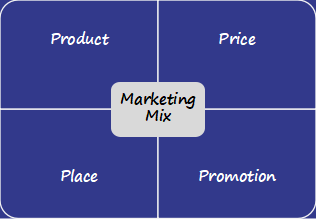
3.3 Marketing Mix (Product, Price, Distribution and Promotion)
When expanding into international markets, it is essential to develop a marketing strategy that is tailored to each specific market. This ensures that your approach resonates with local consumers and maximizes your chances of success. To achieve this, the strategy must be adapted to four key elements:
- Product: Adaptation of characteristics, brand and design.
- Price: Competitive strategies, tariffs and logistics costs.
- Place: Suitable local channels.
- Promotion: Campaigns adapted to the culture and consumption habits.
Contents of this subsection:
TIP:
Move directly to the following subsections: Product Strategy / Pricing Strategy / Place Strategy / Promotion Strategy if you are already familiar with the 4 Ps of the Marketing Mix and are only interested in exploring the possible strategies within each dimension to navigate an internationalisation process.
3.3.1 Product
The tastes, needs and, therefore, demands in the global market may not coincide with those generated in the local market, so it must be clear which products to export in each of the cases, so we must ask ourselves:
- What are the most suitable products for new markets?
- What are the main strengths of my product?
- Do I have to bring all my products in at once?
- What degree of adaptation do they need?
- What are inseparable elements and product characteristics?
- How are they developed and marketed?
In general, the choice of the asset to be internationalised is guided by 2 basic elements:
- Profitability potential in the target market (profits).
- Need to adapt to destination (risk of introduction).
These 2 variables act in the opposite way, so it is advisable to select the product with the highest profitability and the least risk or adaptation needs to the target market.
In addition, in the product variable, it is necessary to take into account the following factors:
- Product levels.
- Product Policies
- Branding, packaging, packing and labeling
Information on each of them is presented below:
Product Levels
When developing a product strategy for international markets, it is critical to identify and understand the diverse levels at which the product is presented, as each level offers specific value to the customer:
- Essential Product: This level refers to the fundamental benefits that the product provides, that is, the basic need it satisfies. For example, in the case of a mobile phone, the core product would be the ability to communicate.
- Real Product: At this level, the physical and tangible characteristics of the product are described, including its design, quality, style, branding, and functionalities. It is the physical manifestation of the product that the customer purchases, such as the technical specifications of a mobile phone.
- Augmented Product: This level encompasses the additional services and benefits that accompany the product, offering added value that distinguishes it from the competition. Examples of this include warranties, after-sales service, and technical support, which can influence the customer's purchase decision.
Product Policies
To ensure success in international markets, it is crucial to define clear policies that guide the exportable supply for a given market, taking into account:
- Product chosen for the market
- Product shelf life
- Product positioning quality (what standards the product is going to be offered with)
- Warranties and Warranty Terms
- Market-specific product innovations
- Other
Product validation in the target market is essential to determine which policies will be worked under, thus ensuring acceptance and success.
Branding, packaging, packaging and labelling
- Brand – Branding: The choice of brand is a crucial strategic decision. It must be justified if you opt for your own brand or a private label, highlighting the benefits associated with each option. The brand presentation must include the logo, isotype and corporate colours, aligned with the company's Corporate Manual and/or Brand Manual. In this regard, there are cases such as consumer products and specialized profile products, in which the brand plays a fundamental role in customer loyalty. It is important that companies that compete with other brands in their segment are able to use effective marketing tools that awaken in the consumer a feeling of "loyalty" towards the brand. A very effective technique is to use the story concept in the marketing campaigns of our product.
- Packaging: It is important that the packaging is not only functional, but also attractive to consumers. The need for the packaging, the material used, and how these aspects offer competitive advantages, such as protection, sustainability, and aesthetics, should be explained.
- Packing: Packing should be undertaken based on the characteristics of the product and the needs of the target market. This must ensure the security of cargo during international transport and meet the expectations of direct buyers, such as importers, agents and distributors. In some cases, packing plays a key role in the product distribution chain, particularly for fragile products that require special transport such as CO2, O2 and air flow containers, etc., so that the end consumer receives the product in perfect condition.
- Labelling: The product label must contain precise commercial and technical information, complying with the local regulations of the target market and facilitating consumers' understanding of the product.
Product Strategy
To address different international markets, two main strategies can be employed:
- Standardization (Quality standards): It consists of offering a uniform product that responds to the demands of the majority of the market, capitalizing on the homogenization of tastes and preferences at a global level.
- Adaptation (Grade): This strategy involves adjusting the product to the specific needs and requirements of each international market, allowing for greater customization and potentially greater acceptance in diverse markets.
- Within the adaptation strategies there are grades of product adaptation depending on the level of performance within a category. In cases of higher grade of product adaptation, we speak of niche product strategies.
3.3.2 Price
Price Analysis Factors
Before establishing a pricing strategy in international markets, it is crucial to conduct a thorough analysis of competitor pricing, using reliable sources.
Setting prices based on competition requires a thorough understanding of margin structures across the distribution chain. Through market research, executives can gather information on retail prices, importing companies, and market shares using tools such as store checks and consultancy reports.
However, obtaining data on the prices at which competitors sell to retailers or importers is challenging, import statistics provide average category prices for products from a given country but they do not reveal prices at the company or brand level.
Since distributors rarely disclose their margins, experienced executives use "reverse price breakdown analysis", which involves reversing the export pricing structure to estimate competitors' costs.
This analysis should answer the following guiding questions:
- What are the direct and indirect competitor prices for like products in the target market? This information allows you to understand the competitive environment and position the product in relation to its competitors.
- What is the average price that direct customers, such as importers, agents or distributors, are willing to pay for the product? This factor is vital to adjust the pricing strategy and ensure that the product is attractive to buyers in the target market.
How could the price variation affect it? It is important to consider price elasticity, seasonality, etc., i.e. how a change in price might influence demand for the product.
Pricing Policy
The price policy must be carefully defined for the exportable supply, taking into account various variables that can affect profitability and competitiveness in the international market. Among the variables to be considered to establish the pricing policy are:
- Payment methods (what are the payment options available for international customers)
- Terms of the negotiation (such as payment terms and deliveries)
- Contract payment terms (based on INCOTERMS) Applicable Incoterm (defining the responsibilities of the company and the buyer with respect to transportation, insurance, and risks)
- Average market price (average price range) and average competitor price.
- Pricing and negotiation considerations (taking into account factors such as purchase volume, payment terms, and customer strength)
- Discount policies and their conditions
- Costs:
- Production costs (costs associated with the production of the product such as materials, labour, other direct production costs such as energy, maintenance, etc.)
- Logistics costs (transport, insurance, duties): These costs vary greatly depending on consignment size and frequency.
- Product margin (assessing the profit margin in relation to the expected or determined price)
- Ability to meet demand at those prices while maintaining the agreed quality and deadlines.
Pricing Strategy
There are several pricing strategies that can be applied depending on the company's objectives and market conditions:
- Low-priced income: Introduce the product at a low price to quickly gain market share, increase sales, and benefit from economies of scale that allow costs and prices to be reduced even further.
- Similar prices: Establish a price similar to that of competitors after a thorough analysis of the market, thus avoiding a price war, especially useful when competitive advantages are not evident or when the company is new to the market.
- Premium Pricing: Set high prices for products that have a clear competitive advantage and are perceived as high value by customers, clearly differentiating themselves from competitors.
3.3.3 Place
Place or distribution is a key element in marketing strategy, as it determines how and where products will reach the end consumer. The choice of distribution strategy should be aligned with the company's business objectives and the characteristics of the target market.
Distribution channel outline
To implement the selected distribution strategy, it is crucial to identify and detail the channels through which the products will be marketed.
The decision on the type of distribution channel will directly depend on the understanding and knowledge of the different actors involved in the distribution chain of our product (manufacturer, manufacturer for intermediate products, wholesaler, retailer, specialty stores, hospitality, e-commerce platforms, etc.).
The clear identification of these channels and providing a brief overview of the distributors or importing companies that will be the company's direct customers makes it possible to plan how the product will efficiently reach the end consumer and facilitates supply chain management.
Distribution Policy
Distribution policies must be clearly established to ensure that the product reaches the market effectively. Below are the key variables to consider:
- Coverage: definition of the territorial scope of the distribution: local, regional, national or international
- Channel width: identification of the number of intermediaries at each level of the distribution channel (wholesalers, retailers, etc.)
- Channel length: identification of the number of levels in the distribution chain, from the product to the final consumer.
Place Strategy
Below are three main place strategies, each with its specific focus:
- Intensive: It is marketed on a massive scale, seeking to be present in as many buyers or points of sale as possible.
- Selective: A limited number of buyers are selected, considering aspects or criteria related to the target market, seeking specialised marketing.
- Exclusive: It is marketed to a buyer(s) of specialised products. In certain situations, it occurs with exclusivity contracts, being considered more restrictive than selective one.
3.3.4 Promotion
Product promotion studies the efforts that the company carries out to make the product known and increase its sales to the public: advertising, public relations, product localization, etc.
Types of Promotion Activities
- Direct Activities: It is crucial to identify and select the most effective promotional activities for the company's sector and target market. Some of these activities may include participation in international fairs, trade missions, buyer meetings, business roundtables, showrooms, telemarketing, pop-ups, and multi-brand stores. In special situations, such as contingencies, it is important to consider alternative events that are aligned with the company's business strategy, such as reverse wheels or special activations.Before selecting these activities, it is advisable to carry out prospecting work on the target market. This allows you to understand the business dynamics and ensure that the activities chosen are the most appropriate to achieve the objectives of the business plan.
- Advertising: Advertising plays an important role in product promotion. This may include media relations, such as press releases or releases, presentations of new offerings, press conferences, and sponsorship of sporting or cultural events. It is also important to establish relationships with public and private entities to strengthen the brand's presence in the market.
Digital Presence
Online marketing or Digital Presence is a powerful tool to reach and retain customers in the international market. This plan should begin with an evaluation of the company's current situation in the digital field, considering its web positioning, presence on social networks, and other online platforms.
The objectives of the online marketing plan can vary from attracting new customers to converting and retaining them. To achieve these goals, specific strategies can be implemented in social networks, email marketing campaigns, web optimization, blogs, product review sites, e-commerce platforms, online directories and google listing. It is essential to clearly define KPIs (Key Performance Indicators) and use measurement tools to evaluate the success of campaigns.
The plan should include a detailed timeline of the actions to be executed and the promotional means that will be used to capture the customer's attention, such as graphics, videos, and other communication products.
Promotion Strategy
For effective promotion, it is essential to combine different strategies that span both traditional and digital marketing:
- Advertising and Promotion: Use traditional and digital media to reach the target audience with coherent and attractive messages.
- Public Relations: Establish and maintain strong relationships with the media, institutions, and other entities that may influence the perception of the brand.
- Online Marketing: Develop a strong and consistent presence in the digital environment, using tools and platforms that maximise product visibility and engagement.
These strategies, when implemented correctly, help to create a solid and attractive image of the brand, facilitating entry and consolidation in international markets.
3.4 International Risk Management
International risk management is a crucial component for the success and sustainability of companies looking to expand into global markets.
As organizations venture into new geographies, they must anticipate and manage various risks that may arise due to political, economic, and social instability, financial fluctuations, and cultural differences. These factors can affect business operations, generate financial losses, or complicate negotiations, making it essential to have clear strategies in place to mitigate these risks.
Through a proactive approach and the use of specific tools, companies can reduce uncertainty and enhance the stability of their international transactions, ensuring safer and more effective expansion.
Contents of this subsection:
3.4.1 Country Risk
This risk is associated with a country’s political, economic, and social instability that can affect business operations. Factors such as changes in government, armed conflicts, international sanctions, nationalization of industries, or natural disasters can disrupt trade or increase operating costs. In addition, changes in customs procedures, trade regulations, taxes, or tariffs can directly impact exports and imports. For example, there are countries with strict customs procedures or that can arbitrarily retain products, the export company must take this into account to follow the necessary complaint mechanisms and procedures.
3.4.2 Financial Risk
It involves currency fluctuations that affect the exchange rate, generating losses in foreign currency transactions. It also includes credit and non-payment risk, i.e., the possibility that a customer or business partner will not meet their payments on time or in full, and liquidity risk, where the company faces difficulties in covering financial obligations due to payment delays or banking restrictions.
3.4.3 Cultural Risk
It refers to differences in values, customs, languages and forms of negotiation between countries that can generate misunderstandings or conflicts. For example, different perceptions of time, communication styles (direct or indirect), expectations in business relationships, and approaches to decision-making can complicate collaboration. Lack of knowledge of these differences can affect the effectiveness of negotiations and success in entering new markets.
Several mechanisms help mitigate risks in international trade, ensuring secure and efficient transactions:
- Trade Finance Instruments – Tools like letters of credit (LCs) and bank guarantees provide payment security, reducing counterparty risk.
- Export Credit Insurance – Protects exporters against non-payment due to buyer insolvency or political risks.
- Hedging Strategies – Currency hedging (using forward contracts or options) minimizes risks from exchange rate fluctuations.
- Diversification – Expanding markets and supplier bases reduces reliance on a single country or partner.
- Due Diligence & Compliance – Conducting credit checks, assessing political stability, and ensuring regulatory compliance lower financial and operational risks.
- Contracts & Dispute Resolution – Clearly defined contracts with arbitration clauses help resolve disputes efficiently.
- Supply Chain Financing – Ensures smooth cash flow, reducing financial stress for both buyers and suppliers.
By combining these strategies, businesses can safeguard against uncertainties and enhance trade stability.
3.5 Sources of Finance for Internationalization
Exporters and businesses looking to expand internationally from Suriname can access various resources and financial support programs. Below are key institutions and initiatives that provide funding, trade finance, and business development support:
Trade Finance and Export Credit
- GODO Credit Cooperation Bank: Offers export credit with interest rates ranging from 16-20%.
- KMO Unit (Klein- en Middelgrote Ondernemingen Unit): Supports small and medium-sized enterprises (SMEs) with financing and export-related guidance.
- NOB (Ondernemer - NOB): Provides information and advisory services for entrepreneurs looking to expand internationally.
Financial Support Programs
- Surge Program: A funding initiative designed to support businesses in Suriname seeking growth and internationalization.
- IntEnt Fund: A financial assistance program for companies expanding beyond domestic markets.
- FONDSENBOEK-van-SURINAME (Book of Funds): A reference guide to available financial aid. While some programs may be outdated, businesses are advised to contact donors directly to confirm their current availability.
Business Advisory and Export Assistance
- PUM Netherlands Senior Experts: Provides expert advice and mentorship for Surinamese businesses looking to expand internationally (Suriname - PUM).
- NIKOS (Network Institute for Knowledge and Service): Offers strategic advice and recommends relevant funding opportunities for exporters.
4. First steps to export from Suriname
This section describes the key preparatory steps that businesses in Suriname must take to begin exporting.
It starts with guidance on how to prepare for export, including how to select the right product and classify it correctly under the Harmonized System. It then explains the registration requirements for exporters, such as enrollment with the Chamber of Commerce, the Tax Authority, and Customs.
Finally, it outlines specific export requirements for different sectors, highlighting the importance of digital documentation, product certifications, and compliance with sector-specific regulations, particularly for goods such as fish, agri-food products, and wood.
What you will find in this section:
| Subsection | Description | Further Information |
|---|---|---|
| 4.1 How to prepare to export | Covers the essential steps for preparing to export, including selecting the product for export and determining its classification under the Harmonized System. | Click to learn more about how to prepare to export. |
| 4.2 Registration Requirements for Exporting from Suriname | Includes the necessary steps for exporters in Suriname to register with the Chamber of Commerce, Tax Authority, and Customs, among others requirements. | Click to learn more about registration requirements in Suriname. |
| 4.3 Requirements for export of products and services from specific sectors | This section outlines Suriname's export requirements, focusing on document digitization, product certifications, and sector-specific regulations for items like fish, agri-food, and wood. | Click to learn more about Requirements for export of products and services from specific sectors |
4.1 How to prepare to export
Identification of the product or service to be exported
Before exporting, it is essential to have defined what product you are going to export, it is necessary to identify it within the international categorization of goods, identifying it within the tariff classification.
Tariff classification is a system of categorization of goods (Harmonized System) whose first six digits are called the tariff subheading and identifies a product in any country. In addition, each country in its Customs Tariff adds other digits, usually four, thus completing 10 digits. Below is the example of categorization by tariff code of some of the goods exported from Suriname:
-
- 1006.10 - Rice in the husk (paddy or rough)
- 0803.10 - Bananas and plantains, fresh or dried:
- 0803.10.10.00 - Bananas and plantains Fresh
- 0803.10.20.00 - Bananas and plantains Dried
With the tariff subheading, we can also detail the taxes or customs duties that are charged on goods that enter a country definitively; They also include some market access conditions and preferences granted in free trade agreements.
TIPS:
- It is advisable to access and consult the competent Public Bodies in both the country of origin and destination, for more information on how to classify the tariff heading of your product, in addition to the tariffs (import taxes) applicable to each product according to tariff subheading.
- Consult Suriname Customs for detailed information on tariff classifications and applicable import taxes for products exported from Suriname: Suriname Customs.
- Use the Harmonized Tariff Schedule - U.S. Government Finder to access comprehensive tariff classification data for U.S. imports: Harmonized Tariff Schedule - U.S. Government Finder.
- Visit Access2Markets, the official portal for finding out about barriers to entry into the European Union: Access2Markets.
4.2 Registration Requirements and Procedures for Exporting from Suriname
First of all, the mandatory procedures for any exporter from Suriname include setting up as a company to legitimize the export activity. Therefore, any company or individual intending to export must meet the following prerequisites:
- Registration with the Chamber of Commerce & Industry of Suriname
- Registration with the Suriname Tax Authority (Belastingdienst Tax Office)
- Registration procedure for the Suriname Customs Single Document under the Automated Customs System (ASYCUDA)
Contents of this subsection:
4.2.1 Registration - Chamber of Commerce & Industry of Suriname
This register records information about businesses operating in Suriname. To obtain an extract from the commercial register, you can follow these steps:
- Visit the Chamber of Commerce: Go to the Chamber of Commerce office in Paramaribo.
- Submit a request: Fill out a request form and submit it to the Chamber of Commerce.
- Pay the fee: Pay the required fee for the extract.
- Collect the extract: Once the extract is ready, you can collect it from the Chamber of Commerce.
TIPS:
- Visiting the Chamber of Commerce & Industry of Suriname page will provide you with detailed information on the registration process for businesses operating in Suriname.
- Consult the Ministry of Economic Affairs, Entrepreneurship and Technological Innovation (EZOTI) to access official guidelines and procedures for creating, formalising, and consolidating your business in Suriname.
4.2.2 Registration - Suriname Tax Authority (Belastingdienst Tax Office)
This registration is necessary for tax purposes and to comply with other financial regulations. Procedure for registering with the Ministry of Finance and Planning:
- Obtain a Tax Identification Number (TIN): This is the first step in registering with the Ministry of Finance and Planning. You can obtain a TIN by visiting the tax office and submitting the required documents.
- Register for Value Added Tax (VAT): If your company's annual turnover exceeds a certain threshold, you will be required to register for VAT.1
- Register for other taxes: Depending on the nature of your business, you may also be required to register for other taxes, such as corporate income tax and import duties.
Additional information:
- The specific requirements for registering with the Ministry of Finance and Planning may vary depending on the type of business and the industry in which it operates.
- It is advisable that companies consult with a tax advisor or accountant to ensure that you comply with all of the relevant regulations.
TIPS:
- Visiting the Suriname Tax Authority (Belastingdienst Tax Office) page will provide you with detailed information on the registration process for businesses operating in Suriname.
- Checking out the Suriname VAT Rates, Thresholds, and Registration Guide page on Quaderno will provide you with detailed information on VAT rates, thresholds, and the registration process for businesses operating in Suriname.
4.2.3 Procedures Required - Douane Suriname
Once the registration is completed, companies operating internationally must complete the Suriname Customs Single Document for the Automated Customs System (ASYCUDA*) form: https://douanesuriname.com/enigdocument2.html
* The ASYCUDA world's system for custom clearance is a tool facilitating the calculation, collection and accounting of customs duties. Please note that this procedure is not immediate and is only required at the time of making exports. Therefore, companies in Suriname can sell in the domestic/local market while commercially working on finding international clients.
- Explanation of the routing of your declaration when processed by means of ASYCUDA
The single document is a form used to complete customs formalities when clearing goods. It is a standard form for almost all types of movement of goods under customs control.
The routing is as follows in broad terms:
- After completing the Single Document and after any necessary checks by the IUD, the declaration is ready to be submitted, together with all the required documents, to customs at the declaration point where your goods are located.
- An acceptance check follows, during which attention is paid to the complete completion of the required boxes and the submission of all the required documents.
- Registering within ASYCUDA, assigning a registration number.
- Writing off the manifest.
- Verification with system-technical end verification. The system produces a notification of liability for the cashier.
- After registering with the cashier, you must pay the due rights in the manner you have specified. (We prefer Giro and Bank-cheque traffic)
- The system produces a receipt for you, with your A copy and the receipt you can transport the goods.
TIPS:
- Visiting the Douane Suriname page will provide you with detailed information on the process of completing the Suriname Customs Single Document for the Automated Customs System (ASYCUDA). This form is required for companies to clear goods when exporting.
It is important to make sure you add the correct receipt to the correct documents, and compare the numbers of your declaration.
- Explanation of the routing of the Customs Declaration Procedure
The single document is a form that can be obtained from bookstores and is used to complete customs formalities when clearing goods. This is a standard form for almost all types of goods movement under customs control.
The international transaction (IT) form is also available from bookstores and is intended for the foreign settlement of financial transactions with commercial banks. This form is only required for shipments with a value of more than 500 US dollars.
- The declarant or an authorised representative must complete it themselves using the information stated on the invoice, consignment note and other supporting documents. For certain goods, a permit must also be applied for.In Suriname, it is customary for a declarant to call on the assistance of a customs agent. In Europe, this person is called a declarant and in other parts of the world a customs broker. This is someone who, for a fee, completes the formalities with Customs and other government agencies in order to obtain the goods for someone else.The Certificate of origin of the goods is a fundamental step in the export documentation process. As mentioned in previous sections of the guide; in order to benefit from preferential trade agreements with other countries, companies must prove the origin of their products to the customs authorities of the destination country.
- After completing the form and the other documents, the routing is as follows: the documents are signed and submitted to the Declaration Process Department of Customs in Paramaribo, Nickerie or Zanderij, depending on the location where the goods are located.If the documents are found to be in order after verification, the declarant is issued with an assessment notice. This states how much he must pay the Government in duties.After payment, he receives all submitted documents back, provided with stamps, and with these he goes to the location where the goods are located (Nieuwe Haven warehouse, Nickerie or Zanderij).
- During the inspection, the data on the document is compared with the reality of the goods. If the inspecting official finds that the goods are in order, the document is signed, and the cargo is released for delivery to the handling company.In the case of non-compliant cargo, a note is made based on the types, quantities, goods codes, etc. found. If goods are not declared correctly, sanctions may follow, including the imposition of a fine.
4.3 Requirements for export of products and services from specific sectors
This section includes an introduction referencing “Key tools for export” applicable to any type of company in Suriname, followed by specific requirements for priority sectors.
Key tools for export
Suriname offers certain tools to facilitate the export processes, the Suriname Electronic Single Window (SESW) is a platform is actively used for the digital processing of the documentation that are essential for the export, import and transit of important goods.
Standards and technical requirements
The Suriname Standards Bureau oversees developing and implementing standards and technical regulations for certification of goods and processes and for accreditations of laboratories and testing facilities.
In parallel, certain goods must meet a number of sanitary and phytosanitary requirements.
Restricted goods, which require a license to export:
- Firearms, explosives, and ammunition
- Medicinal plants
- Narcotics and psychotropic substances, pharmaceutical products for humans, and sera
- Endangered wild animal species listed in Appendix I of CITES and their products, including eggs.
- Eggs, skins and hides, and other products of endangered species
- Processed and unprocessed wood, logs
Plants and animals with potential commercial applications as pharmaceutical, aromatic, dying and flavouring products.These licenses or permits are to be obtained at the Invoer, uitvoer en deviezen controle IUD Suriname. The Import, Export and Exchange Control Service (IUD) is a department of the Ministry of Economic Affairs, Entrepreneurship and Technological Innovation (EZOTI) that is responsible for matters of a trade policy nature, in particular the granting of import, export and transit licenses pursuant to the Goods Movement Act. The H-03 form is used for import and export licenses and the G–Import form is used for transit licenses.
Contents of this subsection:
4.3.1 Fishing
Note: This section of the guide for fish exports from Suriname has been developed using the information provided by the FAO's SWM Programme, which can be accessed through the following link: https://www.swm-programme.info/fr/legal-hub/suriname/food-safety
Surinamese companies have to meet a set of steps in order to export fish (or meat), which are the following ones:
- Register and license your business
- Ensure compliance with hygiene and quality standards
- Obtain necessary export permit and certifications
- Packaging, libelling, and marking requirements
- Transport and logistics
- Final export procedures and customs clearance
In addition, the export of fish/meat products is regulated by several legal instruments, which include the following ones:
- The Act on the Movement of Goods,
- the State Order Negative List,
- the Fish Inspection Act,
- the Fish Inspection State Order and the Ministerial Order on General Quality,
- and the Act on the Inspection of Meat and Other Products of Animal Origin.
Below is more information on each step of exporting fish and the role of legal instruments in each step.
Register and license your business (general requirements)
Before exporting fish, companies must ensure they are legally registered and comply with the necessary licensing requirements:
- Business registration: Register with the Suriname Chamber of Commerce & Industry.
- Tax registration: Obtain a Tax Identification Number (TIN) from the Suriname Tax Authority.
- Facility licensing: Ensure that your fishing vessel, processing plant, or fish farm is registered and licensed by the Fish Inspection Institute.
TIP:
For more information about the general requirements and registration process, please visit section Registration Requirements and Procedures for Exporting from Suriname.
Ensure compliance with hygiene and quality standards
To maintain food safety, exporters must adhere to strict regulations:
- Facility standards: Meet the hygiene and construction standards outlined in the Ministerial Order on General Quality.
- Personnel hygiene: Workers must wear protective clothing and undergo annual medical examinations.
- Quality inspection: Fish must be inspected by a certified quality manager at each landing or processing stage.
- Cold chain management: Maintain the required temperatures throughout processing and transport.
Obtain necessary export permit and certifications
To legally export fish from Suriname, companies must secure the required documentation:
- Export permit: Apply for an export permit from the Ministry of Agriculture, Livestock and Fisheries.
- Health certificate: Obtain a health certificate issued by the Fish Inspection Institute.
- Veterinary certification: Required for certain fish species and processed seafood.
- Certificate of origin: Prove the fish’s Surinamese origin to benefit from trade agreements.
Attention should be paid to the following articles of the Fish Inspection State Order:
Article 19 (1): Only the following fish products are exported, namely:
- which have been processed in an establishment that complies with the applicable regulations for approval in accordance with the provisions of Article 29 and is inspected in accordance with the provisions of Article 24;
- which have been declared fit for human consumption by the Fish Inspection Institute
- which bear an identification mark on the packaging and on the accompanying documents in accordance with the provisions regarding identification and inspection certification, as set by the Minister;
- which have been introduced in accordance with the provisions of Chapter 4 of this State Order.
Furthermore, we must to take into consideration the following article of the Fish Inspection Act:
Article 14: Only fish products found to be suitable by the Fish Inspection Institute for Human Consumption may be offered for import or export under the conditions and modalities laid down by or by State Order.
TIP:
For more detailed information on obtaining the necessary export permits and certifications, please visit the official website of the Ministry of Agriculture, Livestock, and Fisheries.
Packaging, libelling, and marking requirements
- Labelling: Each package must include product details, batch number, and the quality mark issued by the Fish Inspection Institute.
- Packaging standards: Use corrosion-resistant, impermeable materials that comply with food safety regulations.
- Traceability: Maintain detailed records of product movement from source to export. The law (Fish Inspection Act) requires that operators keep and maintain records to enable traceability. The records must contain data from purchase, production and sales, from receipt to delivery, including export to final destination, as well as other data
Transport and logistics
Fish products must be transported under strict sanitary conditions:
- Cold chain compliance: ensure storage facilities and transportation maintain the correct temperatures.
- Sealed transport: fish products must be shipped in sealed containers to avoid contamination.
- Pre-export inspection: Before shipment, fish must be checked and approved by the Fish Inspection Institute.
Final export procedures and customs clearance
- Customs documentation: submit all required documents, including invoices, export permits, and health certificates, to the Suriname customs authority.
- Inspection at port: a final check by the fish inspection institute ensures compliance before departure.
- International standards compliance: Ensure the shipment meets the import requirements of the destination country.
TIP:
For more detailed information, please visit the FAO's SWM Programme website.
Register and license your business (general requirements)
Before exporting fish, companies must ensure they are legally registered and comply with the necessary licensing requirements:
- Business registration: Register with the Suriname Chamber of Commerce & Industry.
- Tax registration: Obtain a Tax Identification Number (TIN) from the Suriname Tax Authority.
- Facility licensing: Ensure that your fishing vessel, processing plant, or fish farm is registered and licensed by the Fish Inspection Institute.
TIP:
For more information about the general requirements and registration process, please visit section Registration Requirements and Procedures for Exporting from Suriname.
Ensure compliance with hygiene and quality standards
To maintain food safety, exporters must adhere to strict regulations:
- Facility standards: Meet the hygiene and construction standards outlined in the Ministerial Order on General Quality.
- Personnel hygiene: Workers must wear protective clothing and undergo annual medical examinations.
- Quality inspection: Fish must be inspected by a certified quality manager at each landing or processing stage.
- Cold chain management: Maintain the required temperatures throughout processing and transport.
Obtain necessary export permit and certifications
To legally export fish from Suriname, companies must secure the required documentation:
- Export permit: Apply for an export permit from the Ministry of Agriculture, Livestock and Fisheries.
- Health certificate: Obtain a health certificate issued by the Fish Inspection Institute.
- Veterinary certification: Required for certain fish species and processed seafood.
- Certificate of origin: Prove the fish’s Surinamese origin to benefit from trade agreements.
Attention should be paid to the following articles of the Fish Inspection State Order:
Article 19 (1): Only the following fish products are exported, namely:
- which have been processed in an establishment that complies with the applicable regulations for approval in accordance with the provisions of Article 29 and is inspected in accordance with the provisions of Article 24;
- which have been declared fit for human consumption by the Fish Inspection Institute
- which bear an identification mark on the packaging and on the accompanying documents in accordance with the provisions regarding identification and inspection certification, as set by the Minister;
- which have been introduced in accordance with the provisions of Chapter 4 of this State Order.
Furthermore, we must to take into consideration the following article of the Fish Inspection Act:
Article 14: Only fish products found to be suitable by the Fish Inspection Institute for Human Consumption may be offered for import or export under the conditions and modalities laid down by or by State Order.
TIP:
For more detailed information on obtaining the necessary export permits and certifications, please visit the official website of the Ministry of Agriculture, Livestock, and Fisheries.
Packaging, libelling, and marking requirements
- Labelling: Each package must include product details, batch number, and the quality mark issued by the Fish Inspection Institute.
- Packaging standards: Use corrosion-resistant, impermeable materials that comply with food safety regulations.
- Traceability: Maintain detailed records of product movement from source to export. The law (Fish Inspection Act) requires that operators keep and maintain records to enable traceability. The records must contain data from purchase, production and sales, from receipt to delivery, including export to final destination, as well as other data
Transport and logistics
Fish products must be transported under strict sanitary conditions:
- Cold chain compliance: ensure storage facilities and transportation maintain the correct temperatures.
- Sealed transport: fish products must be shipped in sealed containers to avoid contamination.
- Pre-export inspection: Before shipment, fish must be checked and approved by the Fish Inspection Institute.
Final export procedures and customs clearance
- Customs documentation: submit all required documents, including invoices, export permits, and health certificates, to the Suriname customs authority.
- Inspection at port: a final check by the fish inspection institute ensures compliance before departure.
- International standards compliance: Ensure the shipment meets the import requirements of the destination country.
4.3.2 Agri-Food
To export plants, vegetables, and other regulated plant products from Suriname, you must follow these key steps to comply with national and international regulations:
Surinamese companies have to meet a set of steps in order to export agri-food, which are the following ones:
- Obtain an Export Code
- Hire a Quality Manager
- Follow Good Agricultural Practices (GAP) for Production
- Register as a Producer and Obtain a Product Code
- Implement a Traceability System
- Apply for a Phytosanitary Export Inspection
- Be aligned with others important regulations to consider
Obtain an Export Code
Apply for an export code from the Directorate of Agriculture, in collaboration with the Department of Plant Protection and Quality Inspection under the Ministry of Agriculture, Livestock, and Fisheries (LVV).
This code is necessary to be recognized as an official exporter.
Hire a Quality Manager
- Employ a quality manager responsible for the pre-inspection of goods before export.
- This ensures compliance with quality and phytosanitary standards.
Follow Good Agricultural Practices (GAP) for Production
- Most fruits and vegetables must be produced under the GAP system as outlined by the Ministry of LVV.
- GAP ensures safe, sustainable, and high-quality agricultural production.
Register as a Producer and Obtain a Product Code
- Producers must register with the Ministry of LVV to obtain a product code for their goods.
This code helps track products and verify their compliance with regulations.
Implement a Traceability System
- Exporters must have a traceability system that allows authorities to verify the origin and safety of products.
This system must meet the requirements set by the Directorate of Agriculture.
Apply for a Phytosanitary Export Inspection
- Before export, apply for an export inspection at the Plant Protection and Quality Inspection Service of the Ministry of LVV.
- If the goods meet phytosanitary standards, you will receive a phytosanitary certificate, which is required for export.
Important Regulations to Consider
- It is forbidden to export plants, plant products, and other regulated goods without proper approvals and a phytosanitary certificate.
- This applies to both commercial and non-commercial shipments, including gift packages and passenger goods.
- Regulated goods include plants, plant products, packaging materials, containers, soil, and any other material that could spread pests or diseases.
TIP:
- For more information about the general requirements and registration process, please visit section Registration Requirements and Procedures for Exporting from Suriname.
Obtain an Export Code
Apply for an export code from the Directorate of Agriculture, in collaboration with the Department of Plant Protection and Quality Inspection under the Ministry of Agriculture, Livestock, and Fisheries (LVV).
This code is necessary to be recognized as an official exporter.
Hire a Quality Manager
- Employ a quality manager responsible for the pre-inspection of goods before export.
- This ensures compliance with quality and phytosanitary standards.
Follow Good Agricultural Practices (GAP) for Production
- Most fruits and vegetables must be produced under the GAP system as outlined by the Ministry of LVV.
- GAP ensures safe, sustainable, and high-quality agricultural production.
Register as a Producer and Obtain a Product Code
- Producers must register with the Ministry of LVV to obtain a product code for their goods.
This code helps track products and verify their compliance with regulations.
Implement a Traceability System
- Exporters must have a traceability system that allows authorities to verify the origin and safety of products.
This system must meet the requirements set by the Directorate of Agriculture.
Apply for a Phytosanitary Export Inspection
- Before export, apply for an export inspection at the Plant Protection and Quality Inspection Service of the Ministry of LVV.
- If the goods meet phytosanitary standards, you will receive a phytosanitary certificate, which is required for export.
Important Regulations to Consider
- It is forbidden to export plants, plant products, and other regulated goods without proper approvals and a phytosanitary certificate.
- This applies to both commercial and non-commercial shipments, including gift packages and passenger goods.
- Regulated goods include plants, plant products, packaging materials, containers, soil, and any other material that could spread pests or diseases.
4.3.3 Processed food products
Suriname is updating its food export laws to improve food safety and quality, which is regulated mainly by National Food Safety Institute of Suriname (NIVS). These new rules cover everything from processing and inspection to certification and export requirements. The following sections explain the key requirements for processing food, inspections, export conditions, and packaging, as well as the changes to Suriname’s food safety laws.
Surinamese companies have to meet a set of steps in order to export processed food products, which are associated to the following blocks:
- General requirements for food processing
- Compliance with General Requirements for food processing
- Inspection and certification
- Export requirements for food products
- Packaging and transportation
- Final export procedures and customs clearance
General requirements for food processing
- Ensure your business is registered with the Surinamese Chamber of Commerce and Industry (KKF).
- Obtain necessary licenses for food processing and export from relevant authorities, such as the Ministry of Agriculture, Livestock, and Fisheries.
Compliance with General Requirements for food processing
- Registration and authorization of facilities: Processing facilities must be registered and authorized.
- Compliance with hygiene and quality standards: facilities must comply with hygiene and quality standards established in the ministerial Order on General Quality.
- Self-checking systems: The use of self-checking systems such as HACCP (Hazard Analysis and Critical Control Points) is required. This system is recommended by NIVS)
- Water Standards: Only treated water that meets microbiological and chemical standards is allowed for use.
Inspection and Certification
- Quality marks: Products deemed fit for human consumption are affixed with quality marks.
- Rejection of products: Rejected products may be destroyed, used for animal feed, or sent for research.
Export requirements for food products
- Export permit: an export permit is required under national legislation. You must to apply in Apply for an export permit from the Ministry of Agriculture, Livestock and Fisheries.
- Health certificate: a health certificate issued by the relevant authority in Suriname is required for export: National Food Safety Institute of Suriname (NIVS).
- Sanitary compliance: products must comply with the sanitary requirements of the destination country
Packaging and Transportation
- Packaging requirements: packaging must be hygienic and prevent cross-contamination.
- Storage and transportation: Storage and transportation must occur at appropriate temperatures.
- Reused Packaging: Packaging may only be reused if it can be properly cleaned and disinfected.
Final export procedures and customs clearance
- Customs documentation: submit all required documents, including invoices, export permits, and health certificates, to the Suriname customs authority.
- Inspection at port: a final check by the inspection institute ensures compliance before departure.
- International standards compliance: Ensure the shipment meets the import requirements of the destination country.
TIPS:
- For more information about the general requirements and registration process, please visit section Registration Requirements and Procedures for Exporting from Suriname.
- For further sectorial details regarding regulations, procedures, and documentation required for exporting plants, vegetables, and other regulated plant products visit: https://gov.sr/wp-content/uploads/2023/08/LVV-IDB-Newsletter-issue-02.pdf.
General requirements for food processing
- Ensure your business is registered with the Surinamese Chamber of Commerce and Industry (KKF).
- Obtain necessary licenses for food processing and export from relevant authorities, such as the Ministry of Agriculture, Livestock, and Fisheries.
Compliance with General Requirements for food processing
- Registration and authorization of facilities: Processing facilities must be registered and authorized.
- Compliance with hygiene and quality standards: facilities must comply with hygiene and quality standards established in the ministerial Order on General Quality.
- Self-checking systems: The use of self-checking systems such as HACCP (Hazard Analysis and Critical Control Points) is required. This system is recommended by NIVS)
- Water Standards: Only treated water that meets microbiological and chemical standards is allowed for use.
Inspection and Certification
- Quality marks: Products deemed fit for human consumption are affixed with quality marks.
- Rejection of products: Rejected products may be destroyed, used for animal feed, or sent for research.
Export requirements for food products
- Export permit: an export permit is required under national legislation. You must to apply in Apply for an export permit from the Ministry of Agriculture, Livestock and Fisheries.
- Health certificate: a health certificate issued by the relevant authority in Suriname is required for export: National Food Safety Institute of Suriname (NIVS).
- Sanitary compliance: products must comply with the sanitary requirements of the destination country
Packaging and Transportation
- Packaging requirements: packaging must be hygienic and prevent cross-contamination.
- Storage and transportation: Storage and transportation must occur at appropriate temperatures.
- Reused Packaging: Packaging may only be reused if it can be properly cleaned and disinfected.
Final export procedures and customs clearance
- Customs documentation: submit all required documents, including invoices, export permits, and health certificates, to the Suriname customs authority.
- Inspection at port: a final check by the inspection institute ensures compliance before departure.
- International standards compliance: Ensure the shipment meets the import requirements of the destination country.
4.3.4 Processed wood products
To export timber and wood products from Suriname, companies must meet specific requirements related to registration, documentation, and inspections. These requirements cover both the harvesting and processing/trade phases to ensure compliance with national regulations and to demonstrate the legal origin of the timber.
Surinamese companies have to meet a set of steps in order to export wood products, which are associated to the following blocks:
- General requirements for timber/wood products export
- Harvesting requirements
- Processing and trade requirements
- Inspection and export procedures
General requirements for timber Export
Before engaging in timber/wood products export activities, a company must:
- Be registered with the Ministry of Economic Affairs, Entrepreneurship and Technological Innovation.
- Be registered with Chamber of Commerce (KKF)
- Have an export number (specifically for roundwood)
- Have a tax identification number (specifically for roundwood)
- Obtain an export permit, which requires an application for inspection and examination of the timber before export.
TIP:
- Access the required documents for your inspection application by visiting the following link: SBB Timber Export Information
Harvesting requirements
Before timber can be processed or exported, companies must obtain several key documents based on applicable legislation:
| Key Document | Explanation | Legal Authority |
|---|---|---|
| Exploration License | Grants the right to explore a specific area before applying for a concession. Requires a 1% inventory of harvestable species. | SBB |
| Harvesting Licenses (Concessions, Community Forests, Communal Wood Cutting Permits, Incidental Cutting Licenses) | Various types of harvesting rights depending on the area, purpose, and duration. Incidental Cutting Licenses (ICLs) are restricted to salvage logging areas and conversion forests. | SBB |
| Annual Cutting Plan (Jaar Kapplan) | A detailed harvest plan including an inventory of trees, layout of skidding roads, and selection of trees to be felled. Requires approval before implementation. | Created by company, approved by SBB |
| Cutting Register (Kapregister) | A record for each tree or log, documenting key details. | SBB |
| Retribution Receipt | Proof of payment of extraction taxes. | SBB – Tax Directorate |
| Way Bill (Vervoerbiljet) | A document tracking timber transport, ensuring proper registration at SBB checkpoints. | Issued by the concessionaire and transporter, approved by SBB |
Source: TimberTrade Portal
Processing and trade requirements
To process and trade timber legally, companies must comply with the following documentation requirements:
| Key Document | Explanation | Legal Authority |
|---|---|---|
| Registration with the Ministry of Trade, Industry, and Tourism | Proof of company registration for trade activities. | Ministry of Trade, Industry, and Tourism |
| Registration with KKF | Proof of business registration at the Chamber of Commerce. | KKF |
| Examination Report (Keuring) | Exporting companies must apply for an inspection to determine the minimum FOB value, quality, species, volume, and dimensions of timber. | SBB – Department of Production Control |
| Export License (Exportvergunning) | Required for each shipment of roundwood, unprocessed, and roughly processed wood. Includes export tax payment (ranging from 5% to 20% depending on processing level). | Customs |
Source: TimberTrade Portal
Inspection Procedures
Note: The information of this section was provided by SBB.
A valid export permit is required for the export of roundwood, roughly processed wood, and sawn timber. The inspection process ensures the quality, classification, and compliance of Surinamese timber before export.
General Inspection Process
- Application Submission:
- Companies must submit an inspection application to the Production Control Department of the SBB at least one week before shipment.
- For roundwood, it is recommended to apply two weeks in advance, as a pre-inspection is conducted to provide exporter guidance.
- Inspection Scope:
- Verification of FOB Value (Free On Board pricing).
- Assessment of quality, species, assortment, and volume of timber.
- Ensuring compliance with export standards before issuing permits.
- Approval and Export License Issuance:
- Once the inspection is completed, the export permit/license is granted for the shipment.
Exceptions for Small Shipments
Certain low-value wood shipments are exempt from the standard export permit requirements:
- Wooden artworks for exhibitions
- Previously imported wood products (e.g., part of personal relocation shipments)
- Shipments valued under $500
TIP:
- For more information about the general requirements and registration process, please visit section Registration Requirements and Procedures for Exporting from Suriname.
General requirements for timber Export
Before engaging in timber/wood products export activities, a company must:
- Be registered with the Ministry of Economic Affairs, Entrepreneurship and Technological Innovation.
- Be registered with Chamber of Commerce (KKF)
- Have an export number (specifically for roundwood)
- Have a tax identification number (specifically for roundwood)
- Obtain an export permit, which requires an application for inspection and examination of the timber before export.
TIP:
- Access the required documents for your inspection application by visiting the following link: SBB Timber Export Information
Harvesting requirements
Before timber can be processed or exported, companies must obtain several key documents based on applicable legislation:
| Key Document | Explanation | Legal Authority |
|---|---|---|
| Exploration License | Grants the right to explore a specific area before applying for a concession. Requires a 1% inventory of harvestable species. | SBB |
| Harvesting Licenses (Concessions, Community Forests, Communal Wood Cutting Permits, Incidental Cutting Licenses) | Various types of harvesting rights depending on the area, purpose, and duration. Incidental Cutting Licenses (ICLs) are restricted to salvage logging areas and conversion forests. | SBB |
| Annual Cutting Plan (Jaar Kapplan) | A detailed harvest plan including an inventory of trees, layout of skidding roads, and selection of trees to be felled. Requires approval before implementation. | Created by company, approved by SBB |
| Cutting Register (Kapregister) | A record for each tree or log, documenting key details. | SBB |
| Retribution Receipt | Proof of payment of extraction taxes. | SBB – Tax Directorate |
| Way Bill (Vervoerbiljet) | A document tracking timber transport, ensuring proper registration at SBB checkpoints. | Issued by the concessionaire and transporter, approved by SBB |
Source: TimberTrade Portal
Processing and trade requirements
To process and trade timber legally, companies must comply with the following documentation requirements:
| Key Document | Explanation | Legal Authority |
|---|---|---|
| Registration with the Ministry of Trade, Industry, and Tourism | Proof of company registration for trade activities. | Ministry of Trade, Industry, and Tourism |
| Registration with KKF | Proof of business registration at the Chamber of Commerce. | KKF |
| Examination Report (Keuring) | Exporting companies must apply for an inspection to determine the minimum FOB value, quality, species, volume, and dimensions of timber. | SBB – Department of Production Control |
| Export License (Exportvergunning) | Required for each shipment of roundwood, unprocessed, and roughly processed wood. Includes export tax payment (ranging from 5% to 20% depending on processing level). | Customs |
Source: TimberTrade Portal
Inspection Procedures
Note: The information of this section was provided by SBB.
A valid export permit is required for the export of roundwood, roughly processed wood, and sawn timber. The inspection process ensures the quality, classification, and compliance of Surinamese timber before export.
General Inspection Process
- Application Submission:
- Companies must submit an inspection application to the Production Control Department of the SBB at least one week before shipment.
- For roundwood, it is recommended to apply two weeks in advance, as a pre-inspection is conducted to provide exporter guidance.
- Inspection Scope:
- Verification of FOB Value (Free On Board pricing).
- Assessment of quality, species, assortment, and volume of timber.
- Ensuring compliance with export standards before issuing permits.
- Approval and Export License Issuance:
- Once the inspection is completed, the export permit/license is granted for the shipment.
Exceptions for Small Shipments
Certain low-value wood shipments are exempt from the standard export permit requirements:
- Wooden artworks for exhibitions
- Previously imported wood products (e.g., part of personal relocation shipments)
- Shipments valued under $500
4.3.5 Services
Services are in all the activities carried out by human beings; thanks to them they are the greatest contributors to the well-being of citizens, unlike Goods, these are intangible without being able to be seen or touched, however, they can be the object of transaction and satisfy the needs or desires of customers.
Exporting services is an opportunity to participate in the country's growth, and can be a successful internationalization pathway for Surinamese companies. Exporting services is simple, the most important thing is to identify the type of service you want to export, many companies have exported services even without knowing it. Being an exporter of services is selling your services to a person or company that does not reside in the country and receiving a payment in foreign currency, which generates foreign exchange income to the country.
The Importance of Intellectual Property and Copyright in Exporting Services
It is important to note that the services sector is overly broad and encompasses numerous types of services, without specific requirements like those in other analysed sectors (specific registrations, licenses, etc.). Despite this, there are other specific aspects that characterise the services sector and require greater attention compared to other sectors, such as intellectual property and the knowledge of the service being offered.
Intellectual property (IP) and copyright are critical components in the successful export of services from Suriname. Protecting IP ensures that innovative ideas, creative works, and proprietary knowledge remain safeguarded against unauthorised use or infringement, fostering trust and credibility with international partners.
For service providers, copyrights secure the ownership of original works, including software, designs, publications, and multimedia, which are often central to the export value proposition. This protection not only enhances competitiveness but also provides a legal framework to monetise intellectual assets effectively in global markets.
Moreover, adhering to international IP and copyright standards strengthens Suriname's reputation as a reliable trade partner, promoting sustainable economic growth and encouraging foreign investments. It is essential for businesses to understand and integrate IP and copyright considerations into their export strategies to maximise opportunities and mitigate risks in the global marketplace.
Companies can register any original creative work which has been recorded in an electronic format, including:
- Fiction
- Poetry
- Non-fiction
- Scripts
- Music
- Lyrics
- Photographs
- Drawings
- Websites
- Graphics
- Computer programs
- or any other recorded creative work.
To receive proper guidance on this matter, it is recommended that companies consult the Ministry of Economic Affairs, Entrepreneurship and Technological Innovation, as well as industry professionals specializing in Intellectual Property Rights.
TIP:
- For more information about the general requirements and registration process, please visit section Registration Requirements and Procedures for Exporting from Suriname.
Main Functions of Intellectual Property Rights Offices and Professionals:
- Intellectual Property Registration: Manages the registration of trademarks, patents, industrial designs, and other intellectual property rights.
- Rights Protection: Ensures that intellectual property rights are respected and works to prevent and combat infringements, such as piracy and counterfeiting.
- Education and Awareness: Promotes understanding of intellectual property among citizens, businesses, and key sectors, emphasizing its importance for economic development and innovation.
- Support for Exporters: Assists businesses in understanding how to protect their intellectual property assets in international markets, which is crucial for safely exporting goods and services.
- International Compliance: Ensures that Suriname adheres to international intellectual property treaties and agreements, such as those of the World Intellectual Property Organization (WIPO).
4.3.6 Other sectors
Below are some briefly summarised details to consider in the export process for other key sectors in Suriname such as Chemicals and radioactive material.
Export of Chemicals
- Invoice
- Material Safety Data Sheet (MSDS)
- Letter of advice or no objection from NMA (see NIMOS website: NMA Guidelines)
- Bill of Lading in case of importation
- If the bill of lading has not been received, a physical copy must be delivered to the IUD office or emailed to secretariaatiud@gmail.com
Export of radioactive material
- Material Safety Data Sheet (MSDS)
- Storage Letter
- Letter of advice or no objection from NIMOS
TIP:
- For more information about the general requirements and registration process, please visit section Registration Requirements and Procedures for Exporting from Suriname.
5. The supply chain and logistics in international trade
Logistics is essential in global trade, optimizing resources and ensuring compliance with international standards for efficient and effective cross-border exchange. Once buyers have been found and national permits are in place, logistics need to be organized.
Logistics between countries has the following characteristics:
- International logistics is crucial to global trade.
- Optimization of technical, financial, and human resources to improve the productivity and efficiency of global supply chains.
- It facilitates commercial exchange through various modes of transport, adapting to the needs of goods.
- It complies with international regulations and standards, ensuring efficient trade on equal terms.
Therefore, this section describes the key logistical components involved in international trade, beginning with the various modes of transport, such as maritime, air, road, and rail, and the documentation required for each to ensure smooth customs clearance and delivery. It also highlights how to protect goods during international shipping through proper packaging, labelling, and insurance.
Finally, it introduces INCOTERMS, explaining their role in defining the responsibilities and cost allocations between buyers and sellers in global transactions.
What you will find in this section:
| Subsection | Description | Further Information |
|---|---|---|
| 5.1 International Transport: Types and Documentation | This section outlines the different modes of international transport (sea, air, land, rail), emphasizing the importance of proper documentation such as shipping bills, invoices, and customs declarations for efficient logistics operations. | Learn about the types of transport and the required documentation for international shipping. |
| 5.2 Protection of Goods for International Shipping | This section briefly explains how to ensure goods are protected during international transport through appropriate packaging, labelling, insurance, and risk mitigation measures, particularly for sensitive or high-value items. | Discover how to protect goods when shipping internationally. |
| 5.3 INCOTERMS: Definition and Application | This section briefly introduces INCOTERMS, explaining how these standardized trade terms clarify the responsibilities of buyers and sellers regarding delivery, risk transfer, and costs in international trade transactions. | Learn about INCOTERMS and their application in global trade. |
5.1 International transport: types of international transport and documentation
Contents of this subsection:
5.1.1 Logistics and types of transport
In this subsection, you will find essential information to help you understand the key aspects of logistics when exporting goods. Whether you are new to international trade or looking to improve your current logistics strategy, the content is designed to provide a clear overview of the most important elements involved in getting your product to market efficiently and securely.
Specifically, this section covers the following topics:
- Type of logistics: Understand the different approaches to managing the movement and storage of goods, including inbound, outbound, and third-party logistics.
- Logistic process: Learn about the step-by-step process involved in planning, executing, and monitoring the transportation and storage of goods from origin to destination.
- Types of transport: Explore the various modes of transport available—maritime, air, road, and multimodal—and the factors to consider when choosing the most suitable option for your product and destination.
This knowledge will help you make informed decisions to ensure your exports are delivered efficiently, cost-effectively, and in compliance with international standards.
Type of logistics
| TYPE OF LOGISTICS | DEFINITION | FUNCTIONS |
| Production Logistics | Manages the transformation of raw materials into finished products within the company. |
|
| Storage Logistics. | It is responsible for managing the storage of products and raw materials that arrive at the company. |
|
| Distribution Logistics | Responsible for the transport of final products from the company to the consumer or points of sale. |
|
| Reverse Logistics | Manage the return of products and materials in the supply chain, such as the return of defective products or recycling. |
|
| Procurement Logistics | It ensures the supply of raw materials and other inputs necessary for production. |
|
Logistics Process
The International Logistics Process includes the following phases:
- Identification of customer needs: Analyse product demand and delivery times required to adjust production and avoid excess inventory.
- Proper Storage: Determine the right storage conditions by considering the strength of the product, the cold chain, and other logistical aspects.
- Labelling, Packaging, and Packaging: Ensuring that the product is properly labelled and packaged to comply with international trade and customs regulations.
- Selection of the means of transport: Choose the most efficient transport according to cost, distance, delivery time and product characteristics.
- Location of redistribution points: Optimise the distribution network by selecting the most efficient redistribution centres to minimise transportation costs.
- Customs, tax or commercial documentation: Prepare all the necessary documentation for international transport, such as commercial invoices, packing lists and insurance documents.
- Information and control system: Implement monitoring systems to track shipment status and inventory visibility in real-time.
- Involve all actors in the supply chain: Coordinate all actors involved, from suppliers to customers, to ensure that the supply chain runs efficiently.
Types of transport
| Transport | Characteristics | Advantages | Disadvantages | Further Information |
|---|---|---|---|---|
| Maritime | There is great versatility in terms of goods to be transported (solid, liquid or gaseous). | Low cost in large volumes of cargo.
Flexible in terms of load type (volume and weight). Transport safety. |
Long lead times
High bureaucracy and administrative documentation. Insurance cargo is expensive. |
Click to learn more about Maritime Transport |
| Road | For short or medium distances. Perishable or even high-value products. | Great ease of access and contracting of services.
Flexibility in route coordination. Low administrative bureaucracy. A wide range of services covering the entire territory. |
Increased risk of robberies, accidents, road blocks, etc.
Variable cost depending on the routes (tolls and fuel). Limitation in load capacity. Longer transit times. |
Click to learn more about Road Transport |
| Air | For long distances and the need for speed, perishable or high-value products. | Speed to reach long distances.
Shorter delivery times. Greater safety due to less handling of the goods. |
High cost.
Restrictions on the type of goods for safety (gases, flammable liquids, toxic substances, etc.). Load limitations by weight and size. |
Click to learn more about Air Transport |
| Intermodal and multimodal | Combination of two or more modes of transport under a single contract (multimodal) or multiple contracts (intermodal). | Optimization of routes and costs. Greater flexibility in international logistics. Reduces handling and risk of damage. | Complex coordination between carriers. Potential delays at transfer points. Higher initial planning requirement. | Click to learn more about intermodal and multimodal transtpor |
Maritime Transport
Maritime transport is the shipment of goods through the sea, using cargo ships. It is one of the most important and economical methods of moving massive quantities of products over long distances, such as between countries or continents.
The characteristics of maritime transport are:
- Large loads: Ships can carry tons of products such as cars, machinery, food, oil, and more.
- Containers: Most products are transported in metal containers, which make loading and unloading easier.
- Slow, but efficient: Although Sea freight is slower than air freight, it is much cheaper, especially for heavy or bulky products.
- Ports: Goods are loaded and unloaded at ports, which are special seaside areas equipped to handle large ships and containers.
- Global impact: This type of transport is key to international trade, as it connects countries around the world.
It could be said that sea freight is a reliable and economical option for moving goods in massive quantities across long distances by sea.
Road transport
International road freight transport is usually the main one chosen for the sale of goods in order to reach the final recipient. The great advantage of this type of transport is the flexibility to deliver the goods in any area. There are several types of trucks depending on the distances (short/long) and we have a wide variety depending on the size of the goods and the load capacities. We can find, among others, the following types of trucks for transport:
- Rigid trucks.
- Trailers or trailers.
- Rigid trucks.
- Road trains
- Refrigerated trucks
- Open platforms.
Land transport, although not highly recommended for very long journeys, or in countries with a poorly developed road infrastructure, is a type of transport necessary to reach specific destinations for the collection/delivery of goods at the seller/buyer's premises.
Air transport
In this type of transport, we move goods in special cargo planes, or also in the holds of commercial flights. It is a fast and efficient transport, but its disadvantage is the price, as it is very expensive, especially for bulky goods. The planes have a remarkably high operating cost and a fairly limited load. Air freight is mainly used when goods need to be delivered to the end customer as quickly as possible.
We can consider air freight as a good option for sending express couriers, luxury goods, or healthcare and pharmaceutical products.
Other types of transport: intermodal and multimodal
| Type of Transport | Description | Example | Key Difference | |
|---|---|---|---|---|
| Intermodal Transport | Combines several modes of transport (e.g., sea, air, river, land) without changing the unit of cargo during transit. | A global courier company using both ocean freight and land transport for shipments. | Cargo remains in the same unit of transport; no separation of goods along the way. | |
| Multimodal Transport | Uses multiple modes of transport and different load units (e.g., pallets, containers) across various segments of the journey. | An olive oil company hires a carrier to deliver goods to Japan using sea and road transport, where goods are handled in different units like containers or pallets. | Cargo is transported in different units (e.g., containers, pallets), and various load types are used. |
A table is shown with the differences and advantages between both types of transport:
| Aspects | Intermodal Transportation | Multimodal Transport |
|---|---|---|
| Use several types of transports. | YES | YES |
| Transport Document Used | One in each of the types of transport used | A single document covering the entire transport process |
| Shipping Responsibility | The responsibility is shared between the operators of the operation | The responsibility is assumed in full by the carrier in charge |
| Transport coordination | Coordination between several types of transport is necessary | The carrier in charge is the one who coordinates the entire transport |
| Complexity of the transport process | Complex | More complex |
We see a summary of the means of transport, reviewing their main characteristics in terms of capacity, cost, safety and speed:
| TYPES OF TRANSPORT | CAPACITY | COST | SAFETY | RAPIDITY |
| Road | Middle | Low | Low | High |
| Maritime | High | High | High | Casualty |
| Railway | Middle | Middle | High | Middle |
| Air | Casualty | High | High | High |
| Multimodal / Intermodal | Middle | Middle | Middle | High |
It is important to note that the size of the shipment and the cost per kilo is lower when transported in bulk, the customs costs are similar regardless of the means of logistics transport.
Type of logistics
| TYPE OF LOGISTICS | DEFINITION | FUNCTIONS |
| Production Logistics | Manages the transformation of raw materials into finished products within the company. |
|
| Storage Logistics. | It is responsible for managing the storage of products and raw materials that arrive at the company. |
|
| Distribution Logistics | Responsible for the transport of final products from the company to the consumer or points of sale. |
|
| Reverse Logistics | Manage the return of products and materials in the supply chain, such as the return of defective products or recycling. |
|
| Procurement Logistics | It ensures the supply of raw materials and other inputs necessary for production. |
|
Logistics Process
The International Logistics Process includes the following phases:
- Identification of customer needs: Analyse product demand and delivery times required to adjust production and avoid excess inventory.
- Proper Storage: Determine the right storage conditions by considering the strength of the product, the cold chain, and other logistical aspects.
- Labelling, Packaging, and Packaging: Ensuring that the product is properly labelled and packaged to comply with international trade and customs regulations.
- Selection of the means of transport: Choose the most efficient transport according to cost, distance, delivery time and product characteristics.
- Location of redistribution points: Optimise the distribution network by selecting the most efficient redistribution centres to minimise transportation costs.
- Customs, tax or commercial documentation: Prepare all the necessary documentation for international transport, such as commercial invoices, packing lists and insurance documents.
- Information and control system: Implement monitoring systems to track shipment status and inventory visibility in real-time.
- Involve all actors in the supply chain: Coordinate all actors involved, from suppliers to customers, to ensure that the supply chain runs efficiently.
Types of transport
| Transport | Characteristics | Advantages | Disadvantages | Further Information |
|---|---|---|---|---|
| Maritime | There is great versatility in terms of goods to be transported (solid, liquid or gaseous). | Low cost in large volumes of cargo.
Flexible in terms of load type (volume and weight). Transport safety. |
Long lead times
High bureaucracy and administrative documentation. Insurance cargo is expensive. |
Click to learn more about Maritime Transport |
| Road | For short or medium distances. Perishable or even high-value products. | Great ease of access and contracting of services.
Flexibility in route coordination. Low administrative bureaucracy. A wide range of services covering the entire territory. |
Increased risk of robberies, accidents, road blocks, etc.
Variable cost depending on the routes (tolls and fuel). Limitation in load capacity. Longer transit times. |
Click to learn more about Road Transport |
| Air | For long distances and the need for speed, perishable or high-value products. | Speed to reach long distances.
Shorter delivery times. Greater safety due to less handling of the goods. |
High cost.
Restrictions on the type of goods for safety (gases, flammable liquids, toxic substances, etc.). Load limitations by weight and size. |
Click to learn more about Air Transport |
| Intermodal and multimodal | Combination of two or more modes of transport under a single contract (multimodal) or multiple contracts (intermodal). | Optimization of routes and costs. Greater flexibility in international logistics. Reduces handling and risk of damage. | Complex coordination between carriers. Potential delays at transfer points. Higher initial planning requirement. | Click to learn more about intermodal and multimodal transtpor |
Maritime Transport
Maritime transport is the shipment of goods through the sea, using cargo ships. It is one of the most important and economical methods of moving massive quantities of products over long distances, such as between countries or continents.
The characteristics of maritime transport are:
- Large loads: Ships can carry tons of products such as cars, machinery, food, oil, and more.
- Containers: Most products are transported in metal containers, which make loading and unloading easier.
- Slow, but efficient: Although Sea freight is slower than air freight, it is much cheaper, especially for heavy or bulky products.
- Ports: Goods are loaded and unloaded at ports, which are special seaside areas equipped to handle large ships and containers.
- Global impact: This type of transport is key to international trade, as it connects countries around the world.
It could be said that sea freight is a reliable and economical option for moving goods in massive quantities across long distances by sea.
Road transport
International road freight transport is usually the main one chosen for the sale of goods in order to reach the final recipient. The great advantage of this type of transport is the flexibility to deliver the goods in any area. There are several types of trucks depending on the distances (short/long) and we have a wide variety depending on the size of the goods and the load capacities. We can find, among others, the following types of trucks for transport:
- Rigid trucks.
- Trailers or trailers.
- Rigid trucks.
- Road trains
- Refrigerated trucks
- Open platforms.
Land transport, although not highly recommended for very long journeys, or in countries with a poorly developed road infrastructure, is a type of transport necessary to reach specific destinations for the collection/delivery of goods at the seller/buyer's premises.
Air transport
In this type of transport, we move goods in special cargo planes, or also in the holds of commercial flights. It is a fast and efficient transport, but its disadvantage is the price, as it is very expensive, especially for bulky goods. The planes have a remarkably high operating cost and a fairly limited load. Air freight is mainly used when goods need to be delivered to the end customer as quickly as possible.
We can consider air freight as a good option for sending express couriers, luxury goods, or healthcare and pharmaceutical products.
Other types of transport: intermodal and multimodal
| Type of Transport | Description | Example | Key Difference | |
|---|---|---|---|---|
| Intermodal Transport | Combines several modes of transport (e.g., sea, air, river, land) without changing the unit of cargo during transit. | A global courier company using both ocean freight and land transport for shipments. | Cargo remains in the same unit of transport; no separation of goods along the way. | |
| Multimodal Transport | Uses multiple modes of transport and different load units (e.g., pallets, containers) across various segments of the journey. | An olive oil company hires a carrier to deliver goods to Japan using sea and road transport, where goods are handled in different units like containers or pallets. | Cargo is transported in different units (e.g., containers, pallets), and various load types are used. |
A table is shown with the differences and advantages between both types of transport:
| Aspects | Intermodal Transportation | Multimodal Transport |
|---|---|---|
| Use several types of transports. | YES | YES |
| Transport Document Used | One in each of the types of transport used | A single document covering the entire transport process |
| Shipping Responsibility | The responsibility is shared between the operators of the operation | The responsibility is assumed in full by the carrier in charge |
| Transport coordination | Coordination between several types of transport is necessary | The carrier in charge is the one who coordinates the entire transport |
| Complexity of the transport process | Complex | More complex |
We see a summary of the means of transport, reviewing their main characteristics in terms of capacity, cost, safety and speed:
| TYPES OF TRANSPORT | CAPACITY | COST | SAFETY | RAPIDITY |
| Road | Middle | Low | Low | High |
| Maritime | High | High | High | Casualty |
| Railway | Middle | Middle | High | Middle |
| Air | Casualty | High | High | High |
| Multimodal / Intermodal | Middle | Middle | Middle | High |
It is important to note that the size of the shipment and the cost per kilo is lower when transported in bulk, the customs costs are similar regardless of the means of logistics transport.
Maritime Transport
Maritime transport is the shipment of goods through the sea, using cargo ships. It is one of the most important and economical methods of moving massive quantities of products over long distances, such as between countries or continents.
The characteristics of maritime transport are:
- Large loads: Ships can carry tons of products such as cars, machinery, food, oil, and more.
- Containers: Most products are transported in metal containers, which make loading and unloading easier.
- Slow, but efficient: Although Sea freight is slower than air freight, it is much cheaper, especially for heavy or bulky products.
- Ports: Goods are loaded and unloaded at ports, which are special seaside areas equipped to handle large ships and containers.
- Global impact: This type of transport is key to international trade, as it connects countries around the world.
It could be said that sea freight is a reliable and economical option for moving goods in massive quantities across long distances by sea.
Road transport
International road freight transport is usually the main one chosen for the sale of goods in order to reach the final recipient. The great advantage of this type of transport is the flexibility to deliver the goods in any area. There are several types of trucks depending on the distances (short/long) and we have a wide variety depending on the size of the goods and the load capacities. We can find, among others, the following types of trucks for transport:
- Rigid trucks.
- Trailers or trailers.
- Rigid trucks.
- Road trains
- Refrigerated trucks
- Open platforms.
Land transport, although not highly recommended for very long journeys, or in countries with a poorly developed road infrastructure, is a type of transport necessary to reach specific destinations for the collection/delivery of goods at the seller/buyer's premises.
Air transport
In this type of transport, we move goods in special cargo planes, or also in the holds of commercial flights. It is a fast and efficient transport, but its disadvantage is the price, as it is very expensive, especially for bulky goods. The planes have a remarkably high operating cost and a fairly limited load. Air freight is mainly used when goods need to be delivered to the end customer as quickly as possible.
We can consider air freight as a good option for sending express couriers, luxury goods, or healthcare and pharmaceutical products.
Other types of transport: intermodal and multimodal
| Type of Transport | Description | Example | Key Difference | |
|---|---|---|---|---|
| Intermodal Transport | Combines several modes of transport (e.g., sea, air, river, land) without changing the unit of cargo during transit. | A global courier company using both ocean freight and land transport for shipments. | Cargo remains in the same unit of transport; no separation of goods along the way. | |
| Multimodal Transport | Uses multiple modes of transport and different load units (e.g., pallets, containers) across various segments of the journey. | An olive oil company hires a carrier to deliver goods to Japan using sea and road transport, where goods are handled in different units like containers or pallets. | Cargo is transported in different units (e.g., containers, pallets), and various load types are used. |
A table is shown with the differences and advantages between both types of transport:
| Aspects | Intermodal Transportation | Multimodal Transport |
|---|---|---|
| Use several types of transports. | YES | YES |
| Transport Document Used | One in each of the types of transport used | A single document covering the entire transport process |
| Shipping Responsibility | The responsibility is shared between the operators of the operation | The responsibility is assumed in full by the carrier in charge |
| Transport coordination | Coordination between several types of transport is necessary | The carrier in charge is the one who coordinates the entire transport |
| Complexity of the transport process | Complex | More complex |
We see a summary of the means of transport, reviewing their main characteristics in terms of capacity, cost, safety and speed:
| TYPES OF TRANSPORT | CAPACITY | COST | SAFETY | RAPIDITY |
| Road | Middle | Low | Low | High |
| Maritime | High | High | High | Casualty |
| Railway | Middle | Middle | High | Middle |
| Air | Casualty | High | High | High |
| Multimodal / Intermodal | Middle | Middle | Middle | High |
It is important to note that the size of the shipment and the cost per kilo is lower when transported in bulk, the customs costs are similar regardless of the means of logistics transport.
5.1.2 Transport contracts and contractual modalities
The contract of carriage is a legal agreement between the carrier and the shipper (or shipper), whereby the carrier agrees to move goods from one point to another in exchange for payment. This contract details the conditions and responsibilities of the transportation of goods, including costs, times, risks, and other relevant aspects.
Depending on the means of transport used (land, sea, air or rail), the contract of carriage may vary in its structure, terms and documentation. Each mode of transport has specific contracts that regulate the rights and obligations of the parties.
The following are some factors that corroborate the importance of the contract of carriage:
- Legal certainty: It clearly establishes the responsibilities and rights of both parties, protecting both the shipper and the carrier.
- Cost optimization: It allows you to negotiate terms that optimise logistics costs.
- Risk reduction: Helps define and manage the risks inherent in freight transportation.
5.2 Protection of Goods for International Shipping
It is very important that the exporter is very clear about what the cargo or merchandise to be transported is going to be like in terms of type, packaging, packaging or transport units. In this way, we will use a mode of transport that best suits the cargo and that can access the destination at the lowest possible cost and with the greatest security.
In international logistics, goods tend to standardise their volumes and dimensions in order to carry out the most efficient and cheap handling possible. By handling similar loads, we increase the safety of the loads and prevent breakage or deterioration of the loads. With the exception of the box, which is the minimum unit, the most common cargo units that we find in international transport are the following:
- Pallets: these are transport platforms on which goods are placed. Its great advantage lies in the ease of movement of goods due to the auxiliary means of lifting that exist internationally. The pallet sizes vary depending on the markets.
- Container: it is a permanent container that allows its filling or emptying and above all the ability to use it repeatedly in case of needing a transfer between transport vehicles. This versatility has been the basis for the rise of this type of cargo, becoming the most widely used in world freight traffic. There are different models of containers depending on the need for transport, but all of them are stackable and have elements that allow them to be handled and moved horizontally or vertically. The most commonly used sizes are 45, 40 and 20 feet, and some large capacity. Another type of container that we find are reefers, refrigerated containers that have a preservation system to maintain a controlled environment or temperatures, recommended for products or foods that require a low temperature. There are 20- and 40- foot models.
We can find the following:
| Container | Characteristics | Interior Dimensions | Door Opening | Tare | Volume |
|---|---|---|---|---|---|
| 20′ Dry (Normal) | Standard containers. Hermetically sealed and without cooling or ventilation. Ideal for dry and non-perishable goods. | C: 5,898 mm
L: 2,350 mm W: 2,390 mm |
L: 2,340 mm
W: 2,280 mm |
2,200 Kg | 33.00 m3 |
| 40′ Dry (Normal) | Standard closed container, suitable for transporting dry goods.
It offers twice the space of the 20-foot container, making it better suited for bulky or less heavy loads. |
C: 12,035 mm
L: 2,350 mm W: 2,393 mm |
L: 2,339 mm
W: 2,274 mm |
3,700 Kg | 67.00 m3 |
| 40′ High Cube Dry (HC) | Similar to the normal 40-foot container, but with higher height (tall cube), allowing for greater internal volume.
Ideal for light but bulky loads, such as textiles or products that require more vertical space. |
C: 12,030 mm
L: 2,350 mm W: 2,690 mm |
L: 2,340 mm
W: 2,579 mm |
3,930 Kg | 76.00 m3 |
| 20′ Reefer (RF) | Refrigerated container, equipped with a temperature control system to keep the goods in a specific range.
It is used for perishable products such as food, pharmaceuticals, flowers, etc. |
C: 5,440 mm
L: 2,294 mm W: 2,237 mm |
L: 2,286 mm
W: 2,238 mm |
2,750 Kg | 27.90 m3 |
| 40′ Reefer (RF) | Similar to the 20ft reefer container, but with twice the capacity. Ideal for large volumes of perishable goods. | C: 11,577 mm
L: 2,294 mm W: 2,210 mm |
C: 11,577 mm
L: 2,294 mm W: 2,210 mm |
3,950 Kg | 58.70 m3 |
| 40′ High Cube Reefer (RF) | Similar to the 40ft reefer container, but with a higher height to allow for greater volume.
Used to transport large quantities of perishable and temperature-sensitive products. |
C: 11,577 mm
L: 2,294 mm W: 2,509 mm |
L: 2,290 mm
W: 2,535 mm |
4,150 Kg | 67.00 m3 |
| 20′ Open Top (OT) | Container without a roof, which is covered with a tarp or removable cover.
Ideal for loads that cannot be loaded through traditional doors or for bulky products that do not fit through normal openings. |
C: 5,893 mm
L: 2,346 mm W: 2,353 mm |
L: 2,338 mm
W: 2,273 mm |
2,200 Kg | 32.00 m3 |
| 40′ Open Top (OT) | Similar to the 20ft Open Top container, but with twice the capacity. It is commonly used for heavy machinery, vehicles, and other high-volume products. | C: 12,056 mm
L: 2,347 mm W: 2,379 mm |
L: 2,343 mm
A: 2,279 mm |
3,800 Kg | 67.00 m3 |
5.3 INCOTERMS (International Commercial Terms): Definition and Application
They refer to the terms agreed between the buyer and seller on how and when the delivery of the products will take place. These terms define responsibilities, costs, and risks for both parties. Delivery terms can vary depending on the type of trade agreement, and a key tool for establishing them is Incoterms (International Commercial Terms).
- They establish who is responsible for transportation, insurance, and customs costs.
- They define when and where risk is transferred from the seller to the buyer.
- They facilitate international trade negotiations by providing a standardised and clear framework on each party's obligations.
Contents of this subsection:
| What key factors should you consider when determining the best terms for your exports? |
| How do the different INCOTERMS impact your responsibilities and costs in international trade? |
5.3.1 Key elements
Key elements of the delivery terms:
-
- Delivery Location:
It is the place where the goods will be delivered to the buyer or their carrier. It can be in the seller's or buyer's country, at a port, airport, warehouse, or directly at the customer's premises. - Seller Responsibilities:
They include preparing the goods, packing them, and making sure they are ready for shipment. Depending on the agreement, the seller may be responsible for transportation, insurance, and customs formalities. - Buyer's Responsibilities:
Generally, the buyer must receive the goods at the agreed point, pay the corresponding taxes and duties, and take care of the final transportation to their destination. - Transportation:
It determines who is responsible for organizing and paying for the transportation of the goods. In some cases, the seller takes care of the transport to the final destination; in others, the buyer must arrange it. - Risks and Costs:
They define when the risk of loss or damage to the goods passes from the seller to the buyer, and who pays the costs at each stage of the delivery process. - Payment terms:
Aligning payment terms with INCOTERMS ensures clarity, reduces disputes, and promotes trust between international trade partners.
- Delivery Location:
IMPORTANCE OF DELIVERY CONDITIONS:
- Avoid confusion: Clearly defining who pays what and when risk is transferred helps avoid misunderstandings between buyer and seller.
- Cost Optimization: Depending on the agreement, one of the parties may negotiate better transportation rates or insurance.
- Risk Mitigation: Knowing at what point risk is transferred helps both parties better plan for and protect their interests.
Delivery conditions are critical to ensure that the business transaction goes smoothly and smoothly.
IMPORTANCE OF PAYMENT TERMS:
Payment terms in international trade are crucial as they define the financial responsibilities between buyers and sellers, ensuring smooth transactions and reducing risks. When aligned with INCOTERMS, payment terms help determine:
- Risk Allocation – INCOTERMS clarify when ownership and risk transfer, impacting payment security.
- Cash Flow Management – Choosing the right payment term (e.g., open account or letter of credit) affects liquidity and financial planning.
- Trade Security – Payment methods like documentary collections or letters of credit help mitigate risks, especially under terms like FOB or CIF where responsibilities differ.
- Compliance & Efficiency – INCOTERMS like DAP or DDP influence who handles duties and logistics, affecting when and how payments are made.
Incoterms are grouped into four categories according to the initial letter (E, F, C, D) that determine the point of delivery of the goods and who bears the costs and risks at each stage of the shipping process:
5.3.2 Types and Differentiation
| Group | INCOTERM | Description | Further Information |
|---|---|---|---|
| Group E (Direct Delivery) | EXW (Ex Works / In Factory) | The seller makes goods available at their premises, and the buyer assumes all costs and risks. | Click to earn about the Group E |
| Group F (Delivery Without Payment of Main Transport) | FCA (Free Carrier) | The seller delivers goods to a carrier, and the buyer arranges and pays for transport. | Click to earn about the Group F |
| FAS (Free Alongside Ship) | The seller delivers goods at the port next to the vessel, and the buyer assumes all risks from that point. | ||
| FOB (Free on Board) | The seller is responsible until the goods are loaded onto the vessel, after which the buyer assumes the risks. | ||
| Group C (Delivery with Payment of Main Transport) | CFR (Cost and Freight) | The seller pays for transportation to the destination port, but the risk is transferred once goods are loaded onto the vessel. | Click to earn about the Group C |
| CIF (Cost, Insurance, and Freight) | Similar to CFR, but the seller also provides insurance up to the destination port. | ||
| CPT (Carriage Paid To) | The seller pays for transport to an agreed location, but risk is transferred when goods are delivered to the carrier. | ||
| CIP (Carriage and Insurance Paid To) | Similar to CPT, but the seller must also provide insurance. | ||
| Group D (Delivery at Destination) | DAP (Delivered at Place) | The seller covers all costs and risks until goods reach the destination, excluding unloading. | Click to earn about the Group D |
| DPU (Delivered at Place Unloaded) | The seller assumes costs and risks until goods are unloaded at the destination. | ||
| DDP (Delivered Duty Paid) | The seller covers all costs, risks, and duties until goods arrive at the destination. |
In addition to defining cost and risk responsibilities, trade finance plays a crucial role in mitigating financial risks associated with different Incoterms. For example, using a letter of credit (LC) can reduce the risk of non-payment when selling under CIF or DAP terms, while export credit can help manage cash flow by financing upfront costs. Trade finance instruments, such as factoring or credit insurance, provide businesses with greater financial security and flexibility when engaging in international trade. Incorporating trade finance strategies alongside Incoterms can enhance risk management and improve overall trade efficiency.
| Incoterms | Trade Finance Tool | Purpose |
| CIF | Letter of Credit (LC) | Reduces risk of non-payment after seller pays for transport and insurance. |
| DAP | Export Credit Insurance | Protects seller against buyer non-payment after delivery. |
| EXW | Pre-Shipment Financing | Provides working capital to seller before shipment. |
| FOB | Post-Shipment Financing | Helps seller manage cash flow after shipment but before payment. |
Table 1: Summary table of cost and risk by type of INCOTERM
| Incoterm | Cost / Risk / Insurance |
Packaging / Verification
|
Cargo to inland transport
|
Inland transport
|
Export procedure
|
Loading at origin terminal
|
Freight
|
Unloading at destination terminal
|
Import procedures
|
Transport to destination
|
Unloading at destination
|
|---|---|---|---|---|---|---|---|---|---|---|---|
| EXW | Cost | ||||||||||
| Risk | |||||||||||
| FCA | Cost | ||||||||||
| Risk | |||||||||||
| CPT | Cost | ||||||||||
| Risk | |||||||||||
| CIP | Cost | ||||||||||
| Risk | |||||||||||
| Sure | |||||||||||
| DAP | Cost | ||||||||||
| Risk | |||||||||||
| DPU | Cost | ||||||||||
| Risk | |||||||||||
| DDP | Cost | ||||||||||
| Risk | |||||||||||
| CF | Cost | ||||||||||
| Risk | |||||||||||
| FOB | Cost | ||||||||||
| Risk | |||||||||||
| FAS | Cost | ||||||||||
| Risk | |||||||||||
| CIF | Cost | ||||||||||
| Risk | |||||||||||
| Sure |
Group E (Direct Delivery)
- EXW (Ex Works / In Factory):The seller makes the goods available in place (factory, warehouse), and the buyer assumes all costs and risks from that moment on. Minimum liability for the seller.
Group F (Delivery Without Payment of Main Transport)
- FCA (Free Carrier):The seller delivers the goods to a carrier or to an agreed location. The buyer arranges and pays for the main transport.
- FAS (Free Alongside Ship):The seller delivers the goods to the vessel at the port of embarkation. The buyer assumes all costs and risks thereafter.
- FOB (Free on Board):The seller is liable until the goods are loaded onto the vessel. From that moment on, the buyer assumes the risks and costs.
Group C (Delivery with Payment of Main Transport)
- CFR (Cost and Freight):
The seller pays the cost of transportation to the port of destination, but the risk is transferred to the buyer once the goods are loaded onto the vessel. - CIF (Cost, Insurance, and Freight):
Similar to CFR, but the seller must also take out insurance for the goods up to the port of destination. - CPT (Carriage Paid To):
The seller pays for transportation to an agreed location, but the risk is transferred to the buyer when the goods are delivered to the carrier. - CIP (Carriage and Insurance Paid To):
Similar to CPT, but the seller must also take out insurance with greater coverage.
Group D (Delivery at Destination)
- DAP (Delivered at Place):
The seller assumes all costs and risks until the goods are delivered to the agreed place, but without unloading them from the means of transport. - DPU (Delivered at Place Unloaded):
The seller assumes the risks and costs until the goods are unloaded at the agreed place. It is the only INCOTERM that includes the obligation to unload the goods. - DDP (Delivered Duty Paid):
The seller assumes all costs and risks, including taxes and duties, until the goods arrive at the agreed location.
6. Standard Documentation and Procedures in International Trade
This section describes the documentation and regulatory requirements necessary for exporting both products and services. It begins with a breakdown of the key commercial documents used in the export of goods, followed by the specific documentation needed for service exports.
It also highlights the main requirements and critical aspects exporters must consider when targeting priority international markets, including the United States, the European Union, and the Caribbean Community (Caricom).
Find out more by selecting the section you are interested in:
| Subsection | Description | Further Information |
|---|---|---|
| 6.1 Custom clearances and documentation for exporting products | This section covers the essential commercial documents required for exporting goods, including invoices, packing lists, certificates of origin, customs declarations, transport documents, and technical information aligned with destination regulations. | Click to learn more about Custom clearances and documentation for exporting products. |
| 6.2 Documentation for Exporting Services | Focuses on the key documents involved in the export of services, such as contracts and invoices, taking into account the intangible nature of the exchange and the formalization of terms agreed with the international client. | Click to learn more about the documentation needed for service exports. |
| 6.3 Requirements and key aspects for exporting to priority markets | Provides an overview of the specific requirements for exporting to key markets such as the United States, the European Union, and the Caribbean Community (Caricom). | Click to learn more about official websites and regulatory bodies regularly for updates. |
6.1 Custom clearances and documentation for exporting products
Contents of this subsection:
6.1.1 Commercial documents
1. Invoice
- 1.1 Provisional proforma invoice
- When sending samples with no commercial value.
- When the buyer applies for an import licence.
- For the opening of a documentary credit.
- 1.2 Commercial invoice
- Most important trade document.
- It is issued once the commercial operation is confirmed.
- Accounting document that will be the basis for the application of customs duties on goods.
2. "Packing list"
- Document issued by the exporter describing the goods.
- It serves as a basis for the inspection and recognition of goods.
- Related to the commercial invoice.
3. Certificates of origin
- It creates the place of origin of the goods.
- It conditions tariff or commercial treatment at the time of entry into a given customs territory.
- Issued by the Suriname Chamber of Commerce & Industy.
6.1.2 Customs declarations
- Presentation on your own behalf
- Filing through a customs representative
6.1.3 Transport documents
- Maritime Bill of Lading
- Air Bill of Lading
- CMR road waybill
- CIM Railway Waybill
- FIATA Multimodal Bill of Lading
6.1.4 Transport insurance (not always necessary)
While not mandatory in all cases, is highly recommended to protect against potential losses or damages during the movement of goods. It provides financial coverage for risks such as accidents, theft, or natural disasters, and its necessity often depends on the Incoterm used, the destination country, and the nature or value of the cargo.
6.1.5 Technical documents (depending on the regulations and non-tariff barriers*)
- Export licenses and permits
- Quality certifications
- Product approvals
- Sanitary or phytosanitary permits and certifications
TIPS:
- Consult the section Requirements for export of products and services from specific sectors of this guide, in order to check whether the export of your products from Suriname requires additional technical documentation.
- Check official sources of Suriname as the country of origin, as well as the competent authorities of the country of destination of the goods, to ensure compliance with the required technical requirements. In section Requirements and key aspects for exporting to priority markets of this guide some information regarding from potential destination countries are provided: United States, European Union and Cariom.
6.2 Documentation for Exporting Services
1. Invoice
- 1.1 Provisional proforma invoice
- When the buyer applies for an import licence.
- For the opening of a documentary credit.
- 1.2 Commercial invoice
- Most important trade document.
- It is issued once the commercial operation is confirmed.
- Accounting document that will be the basis for the application of services taxes duties.
2. Service Provision Contract
6.3 Requirements and key aspects for exporting to priority markets
The information included in this section comes from the official government sources of the markets analysed, so the information, content and links are subject to changes and modifications by the Official Bodies. Interested companies are recommended to check the information on the web links on a recurring basis and directly with the Regulatory Bodies.
On the other hand, the requirements and key aspects focus on Suriname's sectors with the greatest export impact and export potential.
Contents of this subsection:
6.3.1 United States
First of all, below is included a screenshot of the recommended tool mentioned in previous sections (Harmonized Tariff Schedule - U.S. Government) to identify the key requirements and aspects to consider when exporting products to this market:
Illustration 3: Screenshot of the Harmonized Tariff Schedule – United States Government
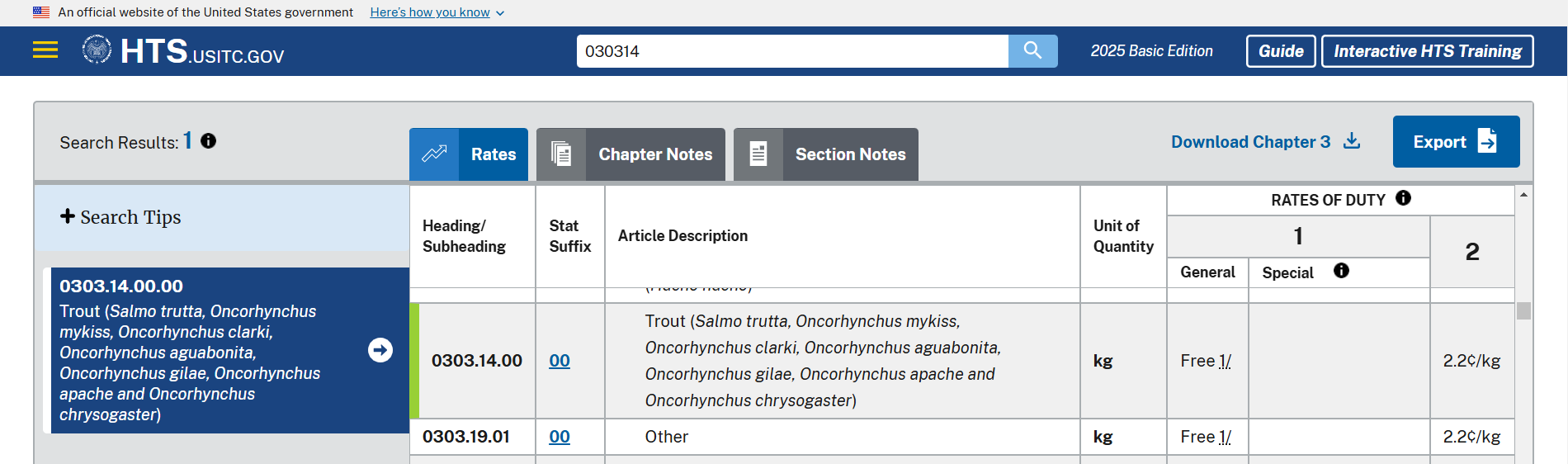
In order to avoid potential problems in the clearance of your merchandise, U.S. Customs and Border Protection (CBP) strongly recommends that you familiarise yourself with CBP policies and procedures prior to actually importing/exporting your goods. You should also be aware of any entry requirements specific to the particular commodity you are importing/exporting, including those of other federal agencies. To assist you, the U.S. Customs and Border Protection offer the following tips for importers and exporters:
Visit the following resources to identify the key requirements and aspects to consider when exporting products to the U.S. market: Harmonized Tariff Schedule - U.S. Government
What kind of license is required to import merchandise into the United States?
CBP does not require an importer to have a license or permit, but other agencies may require a permit, license, or other certification, depending on the commodity that is being imported. There is a listing of other government agencies in the appendix section of the publication Importing.
This section lists resources on trade measures, rules and regulations that affect imports into the United States.
Trade Facilitation Measures
Customs procedures and requirements
- Trade. U.S. Customs and Border Protection
"U.S. Customs and Border Protection has direct responsibility for enhancing U.S. economic competitiveness. By reducing costs for industry and enforcing trade laws against counterfeit, unsafe, and fraudulently entered goods, CBP is working to enable legitimate trade, contribute to American economic prosperity, and protect against risks to public health and safety."
Import prohibitions, restrictions, and licenses
- Prohibited and Restricted Items (U.S. CBP)
There are hundreds of regulations from 40 agencies which are administered by the Customs and Border Protection.
Import licensing
Exporters will need to ensure that the potential customer is licensed.
Sanctions, Controls & Special Procedures
- Sanctions Programs and Country Information (Dept. of the Treasury)
The United States has sanctions regarding a number of countries, regions and regimes and topics/issues, and individual people (i.e., specially designated nationals). The complete list is provided by the Resource of Centre of the Treasury.
Sanitary and phytosanitary (SPS) Requirements
A number of departments and agencies have responsibility regarding human, animal and plant life and health related to the potential import of pests, diseases, disease carrying organisms, disease causing organisms and the risks from additives, contaminants, toxins, disease causing organisms in food, beverages and feedstuff.
- Animal and Plant Inspection Service (APHIS. USDA)
APHIS regulations cover food and agriculture, animal and animal products, organism and vectors, organisms and soil, plant and plant products.
- Food Safety and Inspection Service (FSIS. USDA)
FSIS is responsible for ensuring that the nation's commercial supply of meat, poultry, and egg products is safe, wholesome, and correctly labelled and packaged. FSIS also determines the compliance of other nations' food safety system equivalency with the United States.
- Food and Drug Administration (FDA)
The FDA is charged with protecting consumers against impure, unsafe, and fraudulently labelled products other than the meat, poultry, and egg products regulated by FSIS. FDA is also responsible for the safety of drugs, medical devices, biologics, food additives, dietary supplements, animal feed and drugs, cosmetics, and radiation emitting devices.
FDA Registration
FDA registration is the basic requirement for domestic and foreign establishments that manufacture or market food, drug, API, medical devices, or cosmetic products in the USA. Companies that manufacture, process, pack, or store these products in the United States may be required to register with the FDA. Here are some examples of the types of companies that require FDA registration:
- Food manufacturers, processors, and packers
- Drug manufacturers, packers, and repackers
- Medical device manufacturers and importers
- Cosmetics manufacturers and processors
It's important to note that the FDA has specific registration requirements for each type of product, and the registration requirements for all kinds of companies are not the same.
Visit the following official FDA resources for up-to-date information on the requirements and procedures necessary before exporting: FDA Registration and Listing, Food Ingredients & Packaging, Food Additives & Petitions, Dietary Supplements
- Environmental Protection Agency (EPA)
EPA writes regulations implementing legislation passed by Congress. A SPS-import-related topic is Residual.
- U.S. SPS Measures and the WTO External
The U.S. Enquiry Point is responsible for answering relevant questions in the area of Sanitary and Phytosanitary Measures (SPS).
United States – Suriname relations
The United States and Suriname enjoy a close and constructive partnership. Together, these countries work to promote economic prosperity, deepen trade ties, advance shared security interests, and safeguard democracy and human rights in the region.
The United States Agency for Development (USAID), in partnership with Improving Economies for Stronger Communities (IESC), formally launched in 2024 the regional agricultural program Caribbean Agricultural Productivity Improvement Activity (CAPA).
USAID CAPA focuses on enhancing regional food security by increasing fruit and vegetable productivity, building the capacity of buyers and input suppliers to strengthen relationships with farmers, improving farm-level extension systems, and efficient use of climate data for agricultural decision making which is well aligned with the regional agriculture agenda and this year’s theme of “Climate Smart Agriculture for Sustainable Future”
CAPA is implemented in Barbados, Dominica, Grenada, Guyana, Saint Lucia, Saint Vincent and the Grenadines, Suriname, and Trinidad & Tobago, and has four objectives:
- Objective 1: Increase smallholder market-led production of fruits and vegetables.
- Objective 2: Improve domestic and regional market linkages for smallholder farmers.
- Objective 3: Strengthen public/private sector extension skills and capacity.
- Objective 4: Improve data collection and utilization on the impacts of climate change/weather patterns on agricultural production.
Additionally, the project will utilise an integrated value chain approach to support value addition and practical storage solutions to preserve shelf life while easing the implementation of on-farm technology like climate-smart practices and shade shelters to boost yields.
6.3.2 European Union
First of all, below is included a screenshot of the recommended tool mentioned in previous sections (ROSA - Rules of Origin Self-Assessment of the European Union) to identify the key requirements and aspects to consider when exporting products to this market:
Illustration 4: Screenshot of the Rules of Origin Self-Assessment tool (ROSA) of the European Union
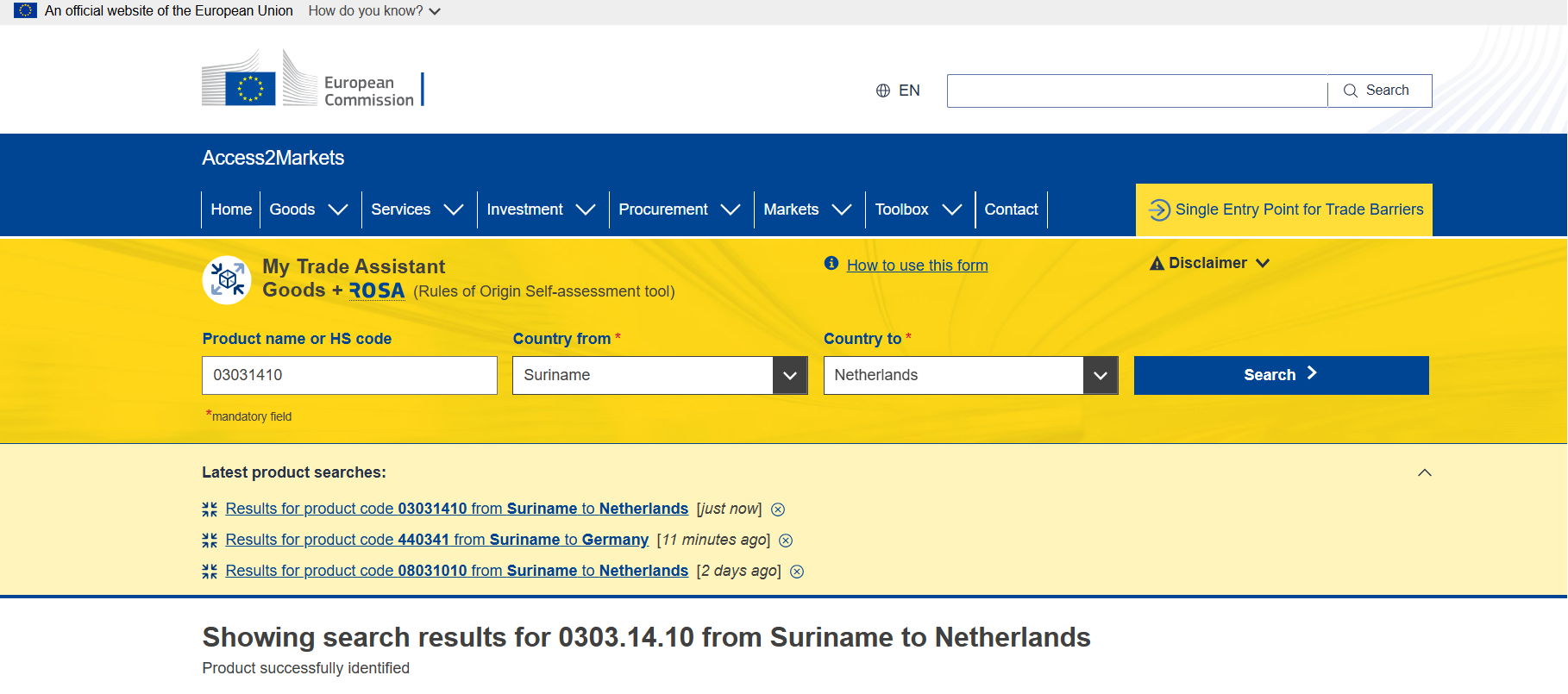
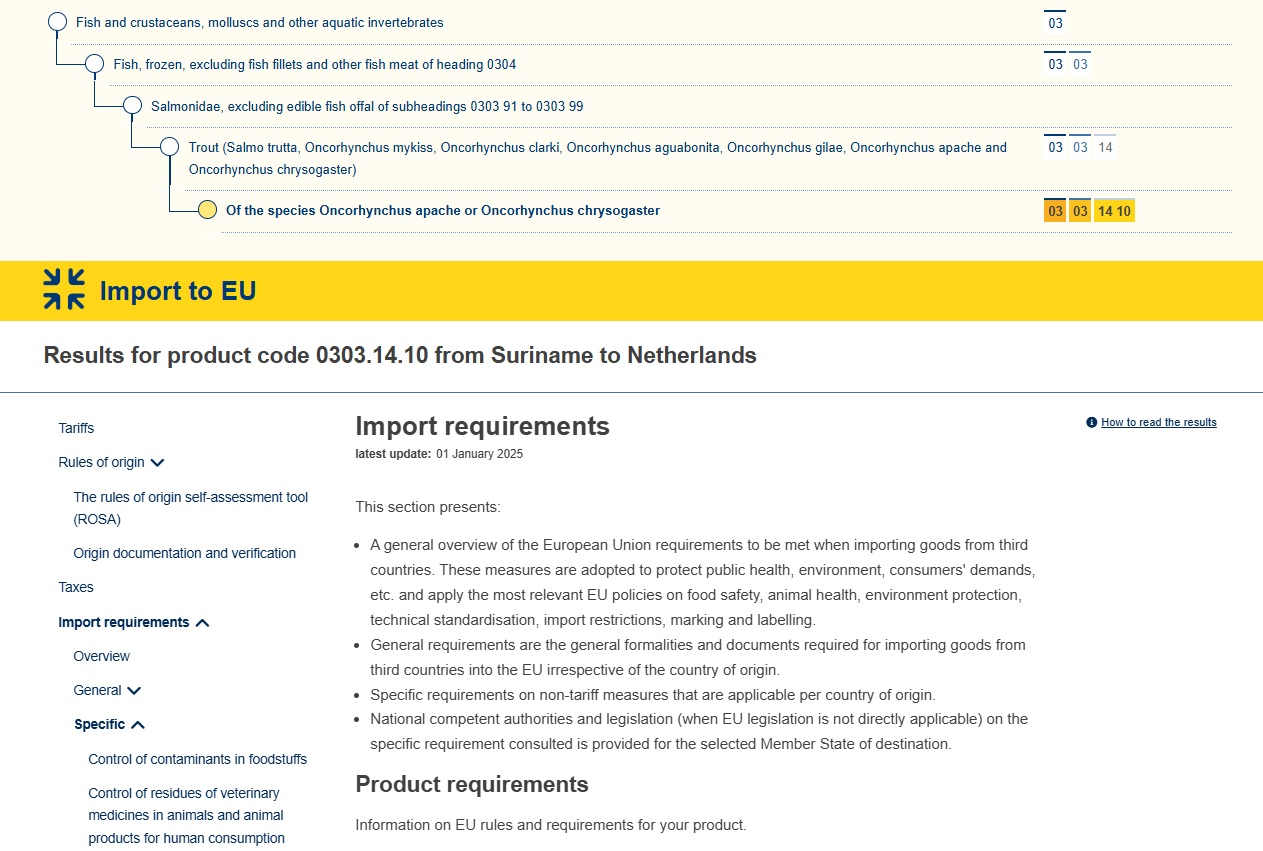 The following is an overview of the most relevant policies of the European Union. It also supplies information sources of the European Commission as well as other European and international institutions where to find further details.
Import Trade Regime
In order to facilitate the structure and understanding of this section of the guide, import restrictions in the European Union will be indicated by priority sectors:
Agricultural Products
Imports into the EU of certain agricultural products may be subject to the presentation of an import certificate, issued by the competent authorities of the EU Member States, prior to clearance for free circulation, upon request from the importer and security deposit returnable on giving proof of the import. Although this is a procedure required by the European importer, it is important that the Surinamese exporting company takes this into account and discusses this matter with the importer in the negotiation process, in order to avoid problems with delivery.
Import certificates serve several purposes such as monitoring trade flows and providing for the administration of tariff quotas or safeguard measures.
European Commission, Trade, Agricultural Policy and Trade
Food and Feed Safety
The central goal of the EU legislation on food safety is to ensure a high level of protection of human health and consumers' interests in relation to food, whereas EU rules on animal feed are aimed towards the protection of human and animal health, and to some extent to environmental protection.
Regulation (EC) 178/2002 (CELEX 32002R0178) lays down the general principles and requirements of Food Law, and covers all stages of food/feed production and distribution. The European Food Safety Authority (EFSA) provides the European Commission with independent scientific advice on all matters with direct or indirect impact on food safety. It is a separate legal entity, independent from the other EU institutions.
Imports of foodstuffs must comply with general conditions and measures, which can be reviewed in the official sources of the European Union regulatory agencies.
If a problem likely to pose a serious risk to human or animal health or to the environment appears or spreads on the territory of a third country, the European Commission may immediately, depending on the seriousness of the situation, adopt protective measures, laying down special conditions or suspending imports of products from all or part of the third country concerned.
Visit the European Commission – Food Safety website for further information on the following topics relevant to food exports to the EU: Animal Feed, General food law, Guidance Document - Key questions related to import requirements and the new rules on food hygiene and official food controls
Animal Health
The EU health legislation on animals and products of animal origin is aimed at protecting and raising the health status of animals (in particular food-producing animals). Imports of animals and products of animal origin must be in accordance with the appropriate health standards and international obligations.
Animals and products of animal origin must comply with a number of general rules, which include:
- The exporting third country must be on a positive list of eligible and authorised countries to export the concerned category of products or animals to the EU.
- Products of animal origin can only be imported into de EU if they come from approved processing establishments of the exporting third country.
- Health certificates signed by an official veterinarian of the competent authority of the exporting third country will accompany imports of animals and animal products.
- Each consignment is subject to health controls at the designated Member State Border Inspection Post (BIP).
However, European authorities can take immediate action by applying temporary protective measures in the event that an outbreak of a disease in a third country presents a serious threat to animal or public health. These measures can comprise the suspension of imports from all or part of the territory concerned or the adoption of special conditions in respect of products from that territory.
TIP:
Visit the European Commission – Health and Consumer Protection section for further information on Animal Health and Welfare, which is crucial for exporters of animal-origin products to the European Union. The section provides details on: Trade and Imports of live animals, Trade and Imports of animal products, General guidance on import and transit rules for live animals and animal products from third countries
Plant Health
The main objective of the plant health measures is to prevent the introduction and/or spread of pests and organisms harmful to plants or plant products across the EU. Regulation (EU) 2016/2031(CELEX 32016R2031)establishes the basic legislation in this field, which is based on the principles of the International Plant Protection Convention (IPPC)- FAO Organisation and the World Trade Organisation Agreement on Sanitary and Phytosanitary Measures
Imports of plants and plant products must comply with certain phytosanitary measures that basically require the goods to:
- be accompanied by a phytosanitary certificate, issued by the designated authorities of the exporting country.
- undergo customs inspections at the designated Border Inspection Post at the point of entry into the EU.
- be imported into the EU by a registered importer with a Member State's official Register; and
- be notified to the customs office before arrival to the point of entry.
Where consignments of plants or plant products originating in third countries, may pose a risk to the territory of the EU, Member States or the EU itself might take Temporary Emergency Measures.
Besides these mandatory provisions, the placing on the EU market of seeds and plant propagating material must comply with specific marketing requirements designed to ensure that these products meet the criteria for health and high-quality. The EU legislation establishes specific conditions for Oil and fibre plants, Cereals, Vegetables, Seed potatoes, Beet seed, Vines, Fruit plants, Fodder plants, Ornamental plants and Forests.
Furthermore, EU legislation has also established a system for the protection of plant variety rights. On the basis of this system, a breeder may be granted a single intellectual property right operative throughout the European Union. The Community Plant Variety Office (CPVO) implements and applies this system.
TIP:
Visit the European Commission – Health and Food Safety section for further information on Plant health and biosecurity, especially important for exporters of plant products to the European Union. This section includes
Marketing standards for agricultural and fishery products
Marketing standards have been laid down in the EU mainly for agricultural and fishery products which are supplied fresh to the consumer, with a view to guarantee the same level of quality for all products placed on the EU market.
- Regulation (EU) 1308/2013 establishes a common organisation of the markets in agricultural products. It provides specific marketing requirements tailored to each product, focusing on aspects such as freshness, size, quality, presentation, and permissible tolerances.
- For fishery products, Regulation (EC) 2406/96 sets common marketing standards that include classification by quality, size or weight, packaging, presentation, and labelling.
Responsibility for ensuring compliance with these standards lies with individual Member States, which must conduct documentary and/or physical inspections of imported agricultural and fishery goods.
TIP:Visit the European Commission – Agriculture and Rural Development section for further information on Food, Farming, Fisheries, relevant for exporters in the agri-food sector
New Internal Market Package for Goods
A New Legal Framework for the modernisation of the New Approach has been adopted in the following package of measures:
- Regulation (EU) 2019/515 (CELEX 32019R0515)
- Regulation (EC) 765/2008 (CELEX 32008R0765) (applicable from 1 January 2010)
- Decision 768/2008/EC (CELEX 32008D0768)
This new proposal aims at removing the remaining obstacles to free circulation of products and ensuring that only safe products circulate around all over the EU market.
TIP:Visit the European Commission – Enterprise and Industry section for further information on Market surveillance for products, which is essential for ensuring that goods exported to the EU comply with safety and quality standards.
EU's General Product Safety Regulation (GPSR): A New Era of Consumer Protection
Applicable from the 13 December 2024, Regulation (EU) 2023/988 of the European Parliament and of the Council of 10 May 2023 on general product safety, also called the General Product Safety Regulation (GPSR), replaces the General Product Safety Directive, and ushers in a new era of consumer protection.
The GPSR applies to consumer products, but those designed exclusively for professional use which subsequently reach the consumer market, should also comply with it. It is complementary to other EU specific safety legislation covering any additional aspects and risks not addressed by the requirements of that specific legislation.
The Regulation introduces several important changes affecting both economic operators (EOs) and authorities, with the aim of improving product safety standards across the EU.
Key changes introduced by the GPSR
- Broader product coverage: The regulation now encompasses a wider range of products, including those sold online, new, used, repaired or reconditioned. It also introduces a list of exemptions:
- medicinal products for human or veterinary use,
- food and feed,
- living plants and animals, genetically modified organisms and microorganisms in contained use,
- animal-derived and by-products,
- plant protection products,
- transport equipment operated by a service provider,
- low-risk aircraft,
- antiques,
- products clearly marked to be repaired or reconditioned prior to use.
- Strengthened risk assessment: EOs must conduct more rigorous risk assessments throughout the product lifecycle.
- Increased accountability for EOs: A responsible economic operator in the EU (an EU manufacturer, importer, authorised representative or a fulfilment service provider) shall be entrusted with tasks relating to the safety of each product covered by the regulation.
- Enhanced market surveillance: National authorities have more powers to conduct more effective inspections of products and take action against unsafe ones. "Safety Gate" focuses on a better exchange of information on measures taken against non-food dangerous products.
- Consumer empowerment: The regulation provides consumers with more information and tools to report unsafe products.
- Cybersecurity measures and AI-related features have been incorporated to safeguard products from external threats and enable product evolution, learning, and predictive capabilities.
TIP:Visit the following official resources for further guidance on product safety requirements and regulations in the EU: Product safety legislation, EU Product safety, Summaries of EU legislation: General product safety regulation (2023)
6.3.3 Caricom
Member States and Associate Members
All CARICOM countries are classified as developing countries. They are all relatively small in terms of population and size, and diverse in terms of geography and population, culture and levels of economic and social development.
CARICOM countries share similarities and challenges. On the one hand they are all in proximity to major markets in North and South American, and most countries, have had to make the transition from agriculture or mining to a service-driven economy, especially tourism and financial services. On the other hand, they have to overcome the challenges of frequent natural disasters, in addition to small size with associated lack of economies of scale and vulnerability to external shocks.
All members subscribe to the Community’s principles outlined in the Revised Treaty of Chaguaramas (2002). Leaders of member states shape the Community’s policies and priorities. They meet twice yearly to discuss issues affecting the Community and the wider world at the Conferences of Heads of Government. All members have an equal say regardless of size or economic status. This ensures that every member has a voice in shaping the Caribbean Community.
MEMBER STATES |
ASSOCIATE MEMBERS |
| Antigua and Barbuda | Anguilla |
| Bahamas | Bermuda |
| Barbados | British Virgin Islands |
| Belize | Cayman Islands |
| Dominica | Curaçao |
| Grenada | Turks and Caicos Islands |
| Guyana | |
| Haiti | |
| Jamaica | |
| Montserrat | |
| Saint Lucia | |
| St Kitts and Nevis | |
| St Vincent and the Grenadines | |
| Suriname | |
| Trinidad and Tobago |
Internal trade policies of Caricom
- Tariff Measures:Under the Common Market agreement, CARICOM member states are expected to allow the free movement of goods and refrain from imposing import duties on products originating within the region. Progress has been made in removing barriers such as stamp duties and surcharges. However, some countries continue to impose taxes on imports from fellow CARICOM states:
- Barbados imposes a 10% stamp duty on CARICOM goods.
- Jamaica applies duties on various goods like milk and steel.
- Trinidad and Tobago levies duties on oil products and excise duties on cigarettes and alcohol.
- Other countries (e.g. Grenada, Belize, Dominica, Saint Lucia) impose duties on specific items such as rum, vehicles, and cigarettes.
- Non-Tariff Measures (NTMs):
While many non-tariff barriers (NTBs) have been reduced in CARICOM Internal Trade, some restrictions remain:(i) Import LicensingMany countries still require import licences for products from CARICOM, especially for agricultural and food products. For instance:- Barbados requires licences for coconuts, food products, and amusement machines.
- Jamaica has a broad licensing regime covering 39 products.
- OECS countries (Antigua and Barbuda, Commonwealth of Dominica, Grenada, Montserrat, Saint Kitts and Nevis, Saint Lucia and Saint Vincent and the Grenadines) typically exempt fellow OECS states but impose licensing on goods from More Developed Countries (MDCs) in CARICOM.
(ii) Import Quotas
Article 21 of the Common Market Annex prohibits quantitative import restrictions between CARICOM members, although exceptions exist (e.g., for sugar, agricultural products, and petroleum). However, there are exceptions to this rule, especially where States have already made prior contractual obligations. Additional exemptions are indicated in various Schedules with respect to particular products or product categories for which special arrangements are in operation.
(iii) Import Prohibitions
Few countries maintain outright import bans, and where they exist, they are usually for sanitary or phytosanitary reasons rather than protectionist motives.
(iv) Price Controls
Price controls were initially allowed as transitional measures when implementing the Common External Tariff (CET). Their use has significantly declined and there's little evidence of their application to CARICOM-origin goods.
(v) Antidumping and Countervailing Measures
CARICOM member states are permitted to apply antidumping and countervailing duties to address imports sold at unfairly low prices or those benefiting from foreign subsidies. These measures are intended to protect domestic industries from material injury. While most member countries (with the exception of the Bahamas, Belize, Grenada, and Guyana) have relevant legislation, only Barbados has actively imposed such duties against products from within the Common Market—specifically on milk and cream from Trinidad and Tobago.
(vi) Safeguard Measures
Safeguards are temporary protective measures taken in response to sudden surges in imports that threaten local industries. Under Articles 28 and 29 of the Common Market Annex, countries may apply such measures to protect their balance of payments or in cases where a domestic industry faces declining demand due to increased imports. Though rarely used, some member states have implemented safeguards: Barbados on pasta, Grenada on brewery products and various others under Article 56, and Saint Lucia on soft drinks and beef patties.
(vii) Sanitary and Phytosanitary (SPS) Measures
Efforts have been made to harmonise regulations on animal and plant health, though progress has been slow:
- Animal health legislation has only been enacted in a few countries (e.g., Antigua and Barbuda, Montserrat, St Kitts and Nevis).
- For plants, attempts have been made to harmonise quarantine systems across the region, although financial constraints remain a barrier.
- Several countries, including Jamaica and Trinidad and Tobago, require import permits and health certificates for animals, plants, and related products.
- Import bans exist on products from areas affected by pests like the Pink Mealybug.
(viii) Technical Regulations and Standards
Article 42(e) of the CARICOM Annex recognises the need for harmonised technical standards. The Caribbean Common Market Standards Council (CCMSC) was established to guide this process.
- Progress has been slow, with only 97 standards agreed by mid-1996, and 27 of these being mandatory.
- Most national standards bodies lack the resources and capacity to implement and monitor standards effectively.
- Only Jamaica and Trinidad and Tobago have well-developed laboratories for testing and certification.
- Some countries rely on foreign standards (e.g., UK or US) due to the absence of national frameworks.
- Many countries are members of international standards bodies such as CODEX, ISO, and OIML.
In countries such as Grenada and Guyana, there are no formal laws regarding labelling and marking. Meanwhile, in more developed countries like Jamaica and Trinidad and Tobago, the Bureaux of Standards manage technical regulations and coordinate with other bodies, such as environmental authorities.
Rules of origin and the application of cumulation provisions in production/manufacturing processes
Exporting products to member countries of the Caribbean Community (CARICOM) requires adherence to specific technical and legal requirements to ensure market access and compliance.
Rules of Origin is based on the general principle of change of customs classification heading, whenever this involves a substantial transformation process. The establishment of specific requirements by product may be necessary. The origin regime allows for cumulative origin, which allows Member States in CARICOM to source inputs into production from the region and still meet the criteria of originating.
Regarding goods produced in the territories which contain inputs from third countries, the c.i.f. value of materials or products from third countries utilized in the process of production should not exceed a percentage of the f.o.b. price of the goods produced or the regional content should not be less than a percentage of the f.o.b. price of the goods produced.
Visit the following resources for detailed information on trade policies and agreements in the CARICOM region: Revised Treaty of Chaguaramas, Trade policy in Caricom: overview of the main trade policy measures (United Nations Economic Commission for Latin America and the Caribbean)
Conclusions and recommendations for exporting to CARICOM countries
While CARICOM has made significant progress toward economic integration, several challenges remain. These include the persistence of certain tariff and non-tariff barriers, inconsistencies in licensing and SPS regulations, and insufficient capacity for standards enforcement.
Despite the complexity of establishing standard requirements for exporting to CARICOM countries, as it comprises numerous nations with different regulations and standards, the following recommendations should be considered by Suriname´s exporters:
- Common External Tariff (CET): CARICOM implements a Common External Tariff on goods imported from non-member countries. Understanding the applicable tariff rates for your products is essential prior to exportation.
- Certificate of Origin: To benefit from preferential tariff rates within CARICOM, it is necessary for exporters from Suriname to provide a Certificate of Origin, verifying that the goods originate from a CARICOM member state.
- Import Licensing: Certain products may require import licenses, especially those in sensitive sectors such as agriculture and pharmaceuticals. It's crucial to verify the specific import licensing requirements of the destination country within CARICOM.
- Technical Standards and Regulations: Products must comply with the technical standards and regulations of the importing country. This includes adherence to quality standards, labelling requirements, and safety regulations. Engaging with the Bureau of Standards or equivalent authority in the target country can provide guidance on specific requirements.
- Sanitary and Phytosanitary Measures (SPS): For agricultural and food products, compliance with sanitary and phytosanitary measures is mandatory to protect human, animal, and plant health. This may involve obtaining health certificates, undergoing inspections, and adhering to quarantine regulations.
- Internal Taxes: Beyond import duties, products may be subject to internal taxes such as Value Added Tax (VAT) or excise duties, which vary by country and product type.
- Prohibitions and Restrictions: Some goods may face import prohibitions or restrictions based on health, safety, or environmental concerns. It's essential to consult the specific regulations of the importing country to identify any such limitations.
- Customs Procedures: Familiarity with the customs procedures of the destination country is vital. This includes understanding documentation requirements, customs valuation methods, and any electronic submission processes in place.
- Trade Agreements and Preferential Access: CARICOM has established trade agreements with various countries and regions, potentially offering preferential access or reduced tariffs. Reviewing these agreements can provide insights into additional benefits or obligations.
Given the diversity among CARICOM member states, specific requirements can vary. Therefore, it's advisable to consult with trade authorities or commercial representatives in the target market to obtain detailed and up-to-date information.
7. FAQs
FAQs - Environment and Motivation for Exporting
1. Why should my company consider exporting?
Exporting allows businesses to expand their market reach, increase revenue, and gain a competitive edge. Companies may seek international markets for growth opportunities, to diversify risks, or to take advantage of trade agreements that facilitate access to new markets.
2. What external factors should I consider before exporting?
Before starting an export venture, it's essential to consider trends in the market, customer demands, and the competitive landscape. Researching market dynamics, including who currently supplies the demand and the size of the market, is crucial. Additionally, understanding the target segment, such as potential buyers and their characteristics, is vital for effective market entry.
3. What internal factors should I evaluate before starting an export strategy?
Internal factors such as your company's administrative, financial, and legal status, as well as market experience, should be evaluated. It's important to assess the potential of your product or service and identify your company’s strengths and weaknesses. Knowing how your product performs in both national and international markets, along with identifying direct competitors, will help in planning your export strategy.
4. What are the main reasons for internationalisation?
Motivations can be:
Proactive: Seeking business growth, technological advancement, and international opportunities.
Reactive: Responding to domestic market saturation, excess production, or competitive pressures.
5. What are the common barriers to exporting?
Export barriers can be classified into four categories:
Knowledge barriers: Lack of market intelligence or information on opportunities.
Resource barriers: Limited production capacity or financial constraints.
Procedural barriers: Bureaucratic challenges, cultural differences, or language barriers.
Exogenous barriers: Exchange rate fluctuations and political instability.
6. How do trade integration agreements benefit Surinamese exporters?
Suriname benefits from several multilateral and bilateral trade agreements that facilitate access to other markets. Agreements like CARICOM, CARIFORUM, and various free trade agreements with countries such as Costa Rica, the Dominican Republic, and the European Union offer reduced tariffs or even tariff-free access to certain markets. These agreements create a competitive edge for exporters.
7. What is the Most-Favoured-Nation (MFN) principle, and how does it affect trade?
The MFN principle ensures that any trade advantage given to one country must be extended to all World Trade Organisation (WTO) members. This means if a country lowers tariffs for one partner, it must do so for all WTO members. It’s a crucial rule in international trade that maintains fairness and non-discrimination.
8. What is the General Agreement on Trade in Services (GATS), and how does it impact Surinamese exporters?
The GATS, established by the WTO, sets rules for international trade in services, aiming for transparency and non-discrimination. It covers four modes of supply: cross-border supply, consumption abroad, commercial presence, and the presence of natural persons. For Surinamese exporters, GATS helps ensure that foreign service providers are treated equally to domestic competitors.
9. How do I benefit from Suriname’s trade agreements?
Surinamese exporters can benefit from various multilateral and bilateral agreements, such as the WTO Treaty, CARICOM agreements, and agreements with countries like Brazil and the UK. These agreements often provide tariff reductions or exemptions, giving exporters access to more competitive conditions in international markets.
10. What are the multilateral trade agreements that benefit Suriname?
Suriname is a party to several multilateral trade agreements, including:
WTO Treaty: A global agreement that sets the rules for international trade, ensuring that trade flows smoothly and predictably.
CARICOM-Costa Rica Free Trade Agreement: This agreement promotes free trade between CARICOM members and Costa Rica.
Free Trade Agreement between CARICOM and the Dominican Republic: Facilitates trade and reduces tariffs between CARICOM countries and the Dominican Republic.
Second Protocol to the Trade and Economic Agreement between CARICOM and Cuba: Expands trade and economic relations between CARICOM and Cuba.
CARIFORUM-EU Economic Partnership Agreement: A trade agreement between CARIFORUM countries and the European Union that promotes economic cooperation and market access.
Economic Partnership Agreement between CARIFORUM and the United Kingdom: Ensures continued preferential trade between CARIFORUM countries and the UK post-Brexit.
11. What are the bilateral agreements that benefit Suriname?
Suriname also benefits from several bilateral agreements, which include:
Agreement with Brazil on Tariff Concessions for Trade in Rice: A deal that allows tariff reductions on rice trade between Suriname and Brazil.
rade Agreement between Suriname and Indonesia: Promotes trade between the two nations, opening opportunities for Surinamese products in Indonesia.
Memorandum of Understanding (MoU) Suriname-Antigua and India:
Memorandum of Understanding (MoU) Suriname-Antigua and Barbuda: A framework for enhancing trade and cooperation between Suriname and Antigua and Barbuda.
MoU Suriname-Barbados: Strengthens bilateral trade relations between Suriname and Barbados.
MoU between Suriname and Dominica: Facilitates trade and cooperation between Suriname and Dominica.
MoU between Suriname and Ghana (Tourism and Mining): Promotes collaboration in sectors like tourism and mining between Suriname and Ghana.
In addition, Suriname has a number of multilateral and bilateral agreements that facilitate trade with other markets. However, not all of these agreements grant reduced or zero tariffs. Exporters should verify the specific benefits and conditions of each agreement before engaging in trade activities.
12. How can I prove the origin of my product for preferential trade agreements?
To take advantage of preferential trade agreements, you must prove the origin of your product through official documents, such as the Certificate of Origin. This document, issued by the relevant authority in Suriname, verifies where the product has been produced, processed, or manufactured and is necessary for customs clearance in the destination country.
FAQs - Strategic Planning for Export
1. Why is strategic planning important for exporting?
Strategic planning ensures that a company carefully evaluates market opportunities, risks, and resource allocation before entering international markets. It helps businesses optimise their chances of success and mitigate potential risks.
2. What key components should an internationalisation roadmap include?
An internationalisation roadmap should contain at least:
- Exportable supply
- Market analysis
- Internationalisation objectives
- Action plan
- Required resources and budget
- Deadlines (schedule)
- Monitoring and control mechanisms
3. What are the main modes of entry into international markets?
The primary methods for entering international markets include:
Indirect Export: Using intermediaries like importers or distributors.
Direct Export: Selling directly to foreign customers.
Partnership Agreements: Collaborations such as licences, franchises, joint ventures, or consortiums.
Local Presence: Establishing physical offices, branches, or subsidiaries in the target market.
4. What factors should be considered when selecting a target market?
Companies should assess:
Market Potential: Economic growth, purchasing power per capita, volume and evolution of imports, and
Accessibility and Risk: Tariff barriers, SPS and technical regulations, political and business risks, ease of doing business, transparency, and corruption levels.
5. How can companies evaluate the economic potential of a market?
By analysing:
- GDP growth trends and future forecasts
- Purchasing power parity per capita
- Volume and trends of imports in the target market
- Exports from similar countries
6. How can companies evaluate the economic potential of a market?
By analysing:
- Tariff barriers.
- Non-tariff barriers.
- Political and commercial risk.
- Ease of doing business.
- Transparency and corruption..
7. How can I analyse a country’s import trends and exports from similar countries
Understanding import trends involves reviewing statistics on trade volumes for relevant products. Also, reviewing exports from countries with similar profiles can reveal potential opportunities. If similar nations are exporting successfully to a target market, it may indicate strong demand for your product.
Useful sources:
8. What are tariff barriers and how do they impact exports?
Tariff barriers are taxes imposed on imported goods, increasing their final price and potentially reducing their competitiveness against local products. Tariffs exceeding 5% for industrial products and 10% for consumer products can be significant obstacles.
9. Where can I find information on tariffs and trade regulations?
Useful sources include:
- Market Access Map: ITC (International Trade Centre) search engine
- Harmonized Tariff Schedule: U.S. Government Tariff and Tariff Finder
- ROSA (Rules of Origin Self-Assessment): Rules of Origin Self-Assessment Tool for Introducing Products into Europe
- WTO's Integrated Data Base (IDB) and Consolidated Tariff Schedules (CTS) database on-line
10. What are Sanitary and phytosanitary measures and technical regulations?
In addition to tariff barriers, there are others to the import of products. These are mainly quantitative restrictions, which establish a limit to the amount of product that a country can import (quotas, licenses), as well as the so-called technical barriers, which have to do with the certification and homologation processes of national agencies. Useful sources include:
- Global Trade Alert: allows search by types of barriers and countries.
- Market Access Map: ITC (International Trade Centre) search engine
- ROSA (Rules of Origin Self-Assessment): Rules of Origin Self-Assessment Tool for Introducing Products into Europe
- TRAINS Portal: UNCTAD https://trainsonline.unctad.org/homedata on trade regulations and Non-Tariff Measures (NTMs).
11. How can companies assess political and commercial risks in a foreign market?
Businesses can use sources like
12. What factors determine the ease of doing business in a country?
The World Bank’s Doing Business Report ranks countries based on factors such as:
- Business regulations and legal frameworks
- Start-up and operational costs
- Infrastructure and commercial environment
13. How can companies evaluate corruption and transparency in a foreign market?
Transparency International’s Corruption Perceptions Index ranks countries based on perceived corruption levels in business and governance, providing insight into the ethical environment of potential markets.
14. What is the Marketing Mix, and why is it important in international markets?
The Marketing Mix refers to the combination of four key elements: Product, Price, Place (Distribution), and Promotion. It is essential for adapting a company's strategy to different international markets by ensuring that the product meets local consumer needs, pricing remains competitive, distribution channels are effective, and promotional activities align with cultural and consumer behaviours.
15. How should a company choose the right product for international markets?
Selecting the right product involves evaluating its profitability potential and the level of adaptation required for the target market. Companies should consider:
- The demand and preferences in the new market.
- The product’s unique strengths.
- The need for adaptation in branding, design, and features.
- The essential characteristics that must remain unchanged.
- The most effective way to develop and market the product internationally.
16. What are the different levels of a product in international marketing?
A product can be analysed at three levels:
- Essential Product: The core benefit it provides (e.g., a mobile phone allows communication).
- Real Product: Its tangible attributes such as quality, design, and brand.
- Augmented Product: Additional services like warranties and after-sales support that enhance customer satisfaction.
17. What factors should be considered in product branding, packaging, and labelling?
When entering new markets, companies should evaluate:
- Branding: Whether to use their own brand or a private label, ensuring alignment with corporate identity.
- Packaging: The material and design must be functional and attractive to consumers.
- Packing: Must ensure product safety during transport and meet international shipping requirements.
- Labelling: Must comply with local regulations and provide clear product information to consumers.
18. What are the main pricing strategies for international markets?
Companies can adopt different pricing strategies, such as:
- Low-priced market entry: Setting a lower price to gain market share quickly.
- Competitive pricing: Aligning prices with market competitors to maintain a stable position.
- Premium pricing: Setting high prices for products with a strong competitive advantage.
19. What factors influence the pricing policy in international trade?
Pricing policies should consider:
- Payment methods and negotiation terms.
- Contract terms based on Incoterms.
- Market and competitor pricing.
- Cost structures including production, logistics, and import duties.
- Ability to meet demand while maintaining quality and profitability.
20. What are the main distribution strategies in international markets?
Companies can choose from three distribution strategies:
- Intensive distribution: Aiming for maximum market coverage.
- Selective distribution: Working with a limited number of specialised distributors.
- Exclusive distribution: Partnering with a single or a few high-profile distributors under exclusivity agreements
21. What factors should be considered when selecting distribution channels?
Companies must analyse:
- The target market’s purchasing behaviour.
- The role of wholesalers, retailers, and e-commerce platforms.
- The geographical scope of distribution (local, regional, or global).
- The length and width of the distribution chain (number of intermediaries and levels in the supply chain).
22. What are the key elements of a successful international promotion strategy?
A well-rounded promotion strategy includes:
- Direct Activities: Trade fairs, business meetings, and sales missions.
- Advertising: Press releases, sponsorships, and media campaigns.
- Digital Presence: Social media marketing, email campaigns, and e-commerce platforms.
- Public Relations: Building relationships with stakeholders to enhance brand credibility.
23. How can businesses manage risks in international trade?
International trade risks include:
- Country Risk: Political, economic, and regulatory changes affecting business operations.
- Financial Risk: Exchange rate fluctuations, non-payment by buyers, and liquidity challenges.
- Cultural Risk: Misunderstandings due to differences in language, customs, and negotiation styles.
24. What strategies can help mitigate international trade risks?
Companies can safeguard against risks through:
- Trade finance instruments (e.g., Letters of Credit).
- Export credit insurance.
- Currency hedging strategies.
- Market and supplier diversification.
- Due diligence on trade partners.
- Well-structured contracts with dispute resolution clauses.
- Supply chain financing to maintain cash flow stability.
By implementing these measures, businesses can enhance their success in international markets and reduce exposure to uncertainties.
FAQs - First steps to export from Suriname
1. What are the first steps to export from Suriname?
To begin exporting from Suriname, businesses must:
- Identify the product or service to be exported.
- Classify the product under the Harmonized Tariff System.
- Seek technical support from specialized professionals.
- Register with relevant authorities.
2. How do I identify my product for export?
Each product must be classified under the international Harmonized Tariff System (HTS). The tariff classification helps determine applicable taxes and market access conditions.
3. Where can I find information on tariff classification?
You can consult:
4. What are the mandatory registration requirements for exporters?
To export from Suriname, you must:
- Register with the Chamber of Commerce & Industry of Suriname.
- Register with the Suriname Tax Authority (Belastingdienst Tax Office).
- Complete the registration process for the Suriname Customs Single Document under the Automated Customs System (ASYCUDA)..
5. How do I register my business with the Chamber of Commerce?
The steps are as follows:
- Visit the Chamber of Commerce office in Paramaribo.
- Submit a request form.
- Pay the required fee.
- Collect the commercial register extract.
6. Who provides guidelines for formalising my company?
The Ministry of Economic Affairs, Entrepreneurship and Technological Innovation (EZOTI) offers guidelines on company formation and formalisation.
7. What are the key steps in processing a customs declaration?
The steps are as follows:
- Completing the Suriname Customs Single Document.
- Submitting the declaration along with supporting documents.
- Verification and registration within ASYCUDA.
- Payment of applicable duties and receiving a receipt.
- Presentation of the correct receipt to release goods for export.
8. What is ASYCUDA and why is it required?
ASYCUDA (Automated System for Customs Data) is a system used for processing customs declarations and calculating duties. Exporters must register for ASYCUDA before making their first export.
9. Customs Declaration Procedure
- What documents are required for the customs declaration?
You need the completed Suriname Customs Single Document, invoice, consignment note, and any necessary permits. - Is it necessary to use a customs broker?
While not mandatory, many exporters hire a customs broker to facilitate the process. - What is the Certificate of Origin and why is it important?
The Certificate of Origin verifies where the goods were produced. It is crucial for benefiting from trade agreements and preferential tariff rates.
10. Are there additional procedures or tools for exporters?
Yes, exporters can benefit from:
- Suriname Electronic Single Window (SESW): Digital processing of export documentation.
- Suriname Standards Bureau: Certification and technical requirements.
11. What are the standards and technical requirements for exporting goods?
The Suriname Standards Bureau oversees the development and implementation of standards and technical regulations for the certification of goods and processes, as well as the accreditation of laboratories and testing facilities. Certain goods must also meet sanitary and phytosanitary requirements.
12. What goods require an export licence?
A licence is required to export the following restricted goods:
- Firearms, explosives, and ammunition
- Medicinal plants
- Narcotics, psychotropic substances, pharmaceutical products for humans, and sera
- Endangered wild animal species listed in Appendix I of CITES, including their eggs and by-products
- Eggs, skins, hides, and other products of endangered species
- Processed and unprocessed wood, logs
- Plants and animals with potential pharmaceutical, aromatic, dyeing, or flavouring applications
Export licences or permits can be obtained from the Import, Export and Exchange Control Service (IUD) under the Ministry of Economic Affairs, Entrepreneurship and Technological Innovation (EZOTI).
13. What are the requirements for exporting fish and meat products?
The export of fish and meat products is regulated by several legal instruments, including the Act on the Movement of Goods, the Fish Inspection Act, and the Inspection of Meat and Other Animal Products Act 2017.
Key requirements include:
- Processing in an approved facility
- Certification of fitness for human consumption by the Fish Inspection Institute
- Identification marks on packaging and documents
- Compliance with the import requirements of the destination country
- Transport in sealed containers
- Maintenance of an export register with details of shipments
Non-compliance with these regulations may result in imprisonment for up to six years or fines up to 12,000,000 guilders.
14. What are the requirements for exporting agri-food products?
The Ministry of Agriculture, Animal Husbandry and Fisheries oversees agri-food exports. Exporters must:
- Have an inspection location
- Submit a producer list for product traceability
- Employ a quality manager
Additionally, each shipment requires a phytosanitary certificate issued by the Plant Protection and Quality Inspections Department. If quarantine pests are detected, the shipment will be rejected.
15. What are the requirements for exporting processed wood products?
To export roundwood, roughly processed wood, and sawn timber, a company must:
- Register with the Ministry of Trade and Industry
- Register with KKF (Chamber of Commerce)
- Obtain an export number and tax identification number (for roundwood)
- Secure an export permit following an inspection
The inspection process ensures quality control and determines the minimum Free on Board (FOB) value. Applications must be submitted at least one week before shipment, and two weeks in advance for roundwood.
16. What are the requirements for exporting services?
Exporting services involves selling services to an international client and receiving payment in foreign currency. Unlike goods, services do not have specific licensing requirements; however, intellectual property (IP) protection is critical. Businesses are encouraged to register copyrights, trademarks, and patents to safeguard their creative works and proprietary knowledge.
The Ministry of Economic Affairs, Entrepreneurship and Technological Innovation provides guidance on intellectual property rights and compliance with international treaties.
17. What are the key export requirements for other sectors?
- Gold Export: Requires online invoice submission, proof of deposit of export duties (15% of customs value), approval by the Foreign Exchange Commission, and a processed G-export form.
- Export of Natural Stones and Minerals: Requires an invoice stamped by the Ministry of Natural Resources, along with a packing list.
- Import/Export of Chemicals: Requires an invoice, Material Safety Data Sheet (MSDS), a no-objection letter from NIMOS, and a Bill of Lading if importing
- Import/Export of Radioactive Materials: Requires an MSDS, storage letter, and a no-objection letter from NIMOS.
FAQs - The supply chain and logistics in international trade
1. What is international logistics, and why is it important?
International logistics is the process of managing the transportation, storage, and distribution of goods across different countries. It is crucial for global trade as it ensures efficient movement of goods while optimising technical, financial, and human resources.
2. What are the main types of logistics in international trade?
- Production Logistics: Manages raw materials to final products.
- Storage Logistics : Handles storage and inventory management.
- Distribution Logistics : Ensures timely transport and delivery.
- Reverse Logistics : Manages returns, recycling, and disposal.
- Procurement Logistics : Ensures a steady supply of materials.
3. What are the main phases of the international logistics process?
The international logistics process includes:
- Identifying customer needs.
- Proper storage and inventory management.
- Labelling, packaging, and packaging compliance.
- Choosing the most efficient transport mode.
- Optimizing redistribution points.
- Preparing customs and tax documentation.
- Implementing tracking systems.
- Coordinating all supply chain actors.
4. What are the different types of international transport?
- Maritime Transport: Cost-effective for large shipments but slower.
- Road Transport : Flexible but limited in capacity.
- Air Transport: : Fast but expensive, ideal for perishable or high-value goods.
- Intermodal & Multimodal Transport : Combines multiple transport modes for efficiency.
5. What is intermodal and multimodal transport?
- Intermodal Transport: Uses different transport modes (e.g., sea and land) but keeps the same cargo unit throughout.
- Multimodal Transport: Involves various transport modes and cargo units (e.g., containers and pallets), with a single carrier managing the entire process.
6. What is a transport contract, and why is it important?
A transport contract is a legal agreement between the shipper and the carrier, outlining responsibilities, costs, and risks associated with transporting goods. It ensures legal certainty, optimizes costs, and minimizes risks.
7. How are goods protected during international shipping?
Goods are typically packed using standardized cargo units such as:
- Pallets: Facilitate handling and transportation.
- Containers: Offer secure, stackable solutions in various sizes (20', 40', 45').
8. What are Incoterms, and why are they important?
Incoterms (International Commercial Terms) define responsibilities, costs, and risks between buyers and sellers in international trade. They help clarify delivery terms, transportation obligations, and cost distribution.
9. What are the main Incoterm categories?
Incoterms are grouped into four categories:
- Group E (EXW): Seller provides goods at origin; buyer handles all costs and risks.
- Group F (FCA, FAS, FOB): Seller delivers goods to a transport point; buyer arranges main transport.
- Group C (CFR, CIF, CPT, CIP): Seller pays for transport; risk transfers at a certain point.
- Group D (DAP, DPU, DDP): Seller assumes responsibility until the goods reach the final destination.
10. What are the key factors to consider when choosing a transport mode?
The best transport mode depends on:
- Capacity: Maritime and rail for bulk shipments; air for limited cargo.
- Maritime and rail are cost-effective; air is expensive.
- Safety: Rail and maritime offer stability; road transport has higher risk.
- Speed: Air transport is fastest; maritime and rail are slower.
11. How do I choose the best transport mode for my goods?
The choice depends on factors like cost, speed, load capacity, and safety. For example:
- Low-cost, large shipments: Maritime transport
- Fast delivery, perishable goods: Air transport
- Flexible delivery: Road transport
- Bulk goods over long distances: Rail transport
FAQs - Standard Documentation and Procedures in International Trade
1. What are the main documents required for exporting products?
Exporting products typically requires the following documents:
- Commercial documents: Invoices (provisional proforma and commercial invoice) and packing list.
- Customs declarations: Submitted by the exporter or a customs representative.
- Transport documents: Bill of lading (maritime and air), road waybill (CMR), railway waybill (CIM), and FIATA multimodal bill of lading.
- Certificates of origin: Issued by the Chamber of Commerce or an authorised entity.
- Technical documents: Export licences, quality certifications, product approvals, and sanitary or phytosanitary permits (if required).
- Transport insurance: Not always mandatory but recommended.
2. What is a provisional proforma invoice, and when is it used?
A provisional proforma invoice is used in the following cases:
- When sending samples with no commercial value.
- When the buyer applies for an import licence.
- For the opening of a documentary credit.
3. What is a commercial invoice, and why is it important?
A commercial invoice is the most important trade document. It:
- Is issued once the commercial operation is confirmed.
- Serves as an accounting document.
- Forms the basis for customs duties application.
4. What is a packing list, and why is it necessary?
A packing list:
- Describes the goods being shipped.
- Serves as a basis for inspection and recognition of goods.
- Is related to the commercial invoice.
5. What is a certificate of origin, and why is it required?
A certificate of origin:
- Confirms the place of origin of the goods.
- Determines tariff or commercial treatment upon entry into a customs territory.
- Is issued by the Chamber of Commerce or another authorised entity.
Documentation for Exporting Services
6. What documents are required for exporting services?
The key documents for exporting services include:
- Invoices (provisional proforma and commercial invoice).
- Service provision contract (if applicable).
Requirements and Key Aspects for Exporting to Priority Markets
7. What are the key considerations for exporting to the United States?
- Customs Procedures: Familiarise yourself with U.S. Customs and Border Protection (CBP) policies.
- Licences: CBP does not require an import licence, but other agencies may.
- Sanitary and Phytosanitary (SPS) Requirements: Compliance with APHIS (USDA), FSIS (USDA), and FDA regulations is necessary.
- FDA Registration: Required for companies exporting food, drugs, medical devices, and cosmetics.
- Trade Facilitation Measures: CBP enforces trade laws to ensure compliance and prevent fraudulent goods.
8. What are the main requirements for exporting to the European Union?
- Import Trade Regime: Certain agricultural products require import certificates.
- Food and Feed Safety: Compliance with Regulation (EC) 178/2002.
- Animal and Plant Health: Products of animal and plant origin must meet EU health and safety standards.
- Marketing Standards: Agricultural and fishery products must comply with EU marketing regulations.
- General Product Safety Regulation (GPSR): Applicable to consumer products from 13 December 2024.
9. What are the requirements for exporting to CARICOM countries?
- Common External Tariff (CET): Understanding tariff rates is essential.
- Certificate of Origin: Required for preferential tariff treatment.
- Import Licensing: Some products require special import licences.
- Technical Standards: Compliance with quality and safety regulations of the destination country.
- Sanitary and Phytosanitary Measures: Products must meet health and safety regulations.
For more information, it is recommended to consult official sources and regulatory bodies in the respective markets.